Cultivating the field of the future.
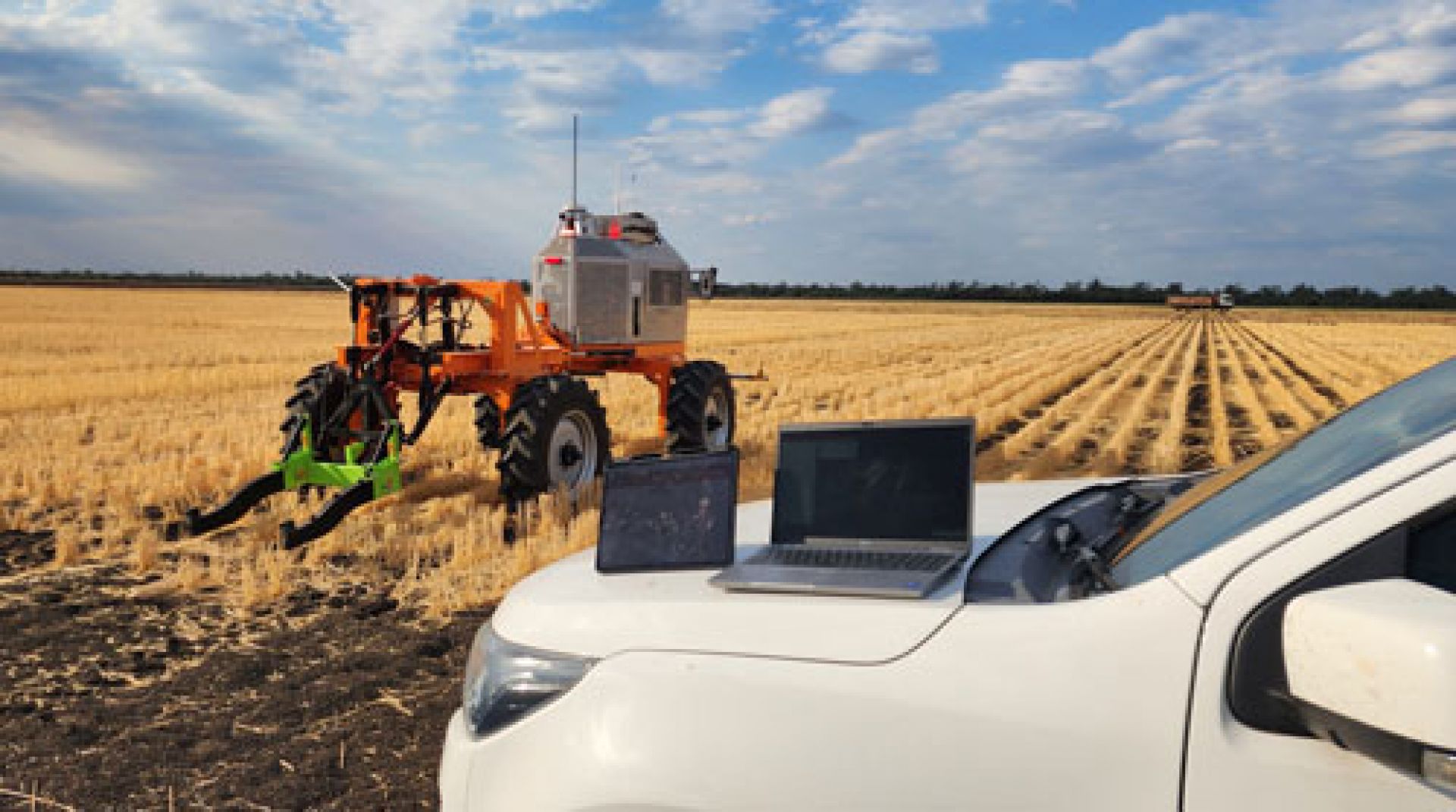
Groundbreaking automation for a soil scanning process vital to planning successful broadacre crops has been developed at our Central Queensland Smart Cropping Centre (CQSCC).
Electromagnetic soil surveying has long been used to identify variability in soils.
This includes assessment of salinity, water and clay content, providing enhanced insights to the grower about what is occurring beneath the surface.
The process usually involves an EM38 survey unit mounted on a sledge being dragged behind an all-terrain vehicle, but in a possible world-first, the team at the CQSCC has developed an automated scanning process.
This innovation involves the use of a hitch device to mount the EM38 survey unit onto SwarmFarm’s robot Sunny, maintaining proximity to the ground and sufficient distance from the vehicle to avoid interference.
Conductivity measurements are collected across the paddock and geo-referenced to enable interpolation of the data to create a map highlighting the soil variability and inform management practices.
The CQSCC team collaborated with SwarmFarm and Data Farming to develop this solution. It uses SwarmFarm’s autonomous tractors integrated with Data Farming’s soil mapping technology and data analytics.
CQSCC Senior Innovation Broker, Alicia Dunbar, says this collaboration is a great demonstration of 2 stand-out Queensland AgTech companies working with us to deliver innovative solutions to tackle the challenges agriculture is facing.
“This technology is now within reach for producers, and our work to deliver the automation of the process is a significant enabler to put this information in more producers’ hands more easily, quickly and cost-effectively,” Alicia says.
“This solution will have a significant impact on farmers, particularly in managing soil water and drought conditions through multi-temporal surveying.
“By enabling precise, repeated soil water assessments over time, this innovation helps farmers make informed decisions about irrigation and crop management, leading to better resource utilisation and improved farm agronomy.
The ability to monitor and respond to soil water variability dynamically is a game-changer for drought resilience and overall farm productivity,” she says.
“It has the potential to save hundreds of hours on-farm, freeing farmers, staff and resources for other tasks.”
Alicia says the solution is a great example of interoperability in AgTech: seamless data exchange and integration across different systems and devices to provide technology synergy and improved return on investment, costs and time for producers.
“Interoperability is essential for realising the full potential of digital and technological innovations in agriculture, allowing us to drive efficiency, productivity, and sustainability in farming practices,” Alicia says.
Last updated: 05 Jun 2024