A Queensland grazing property improved productivity with rotational grazing, better fencing, and improved cattle genetics.
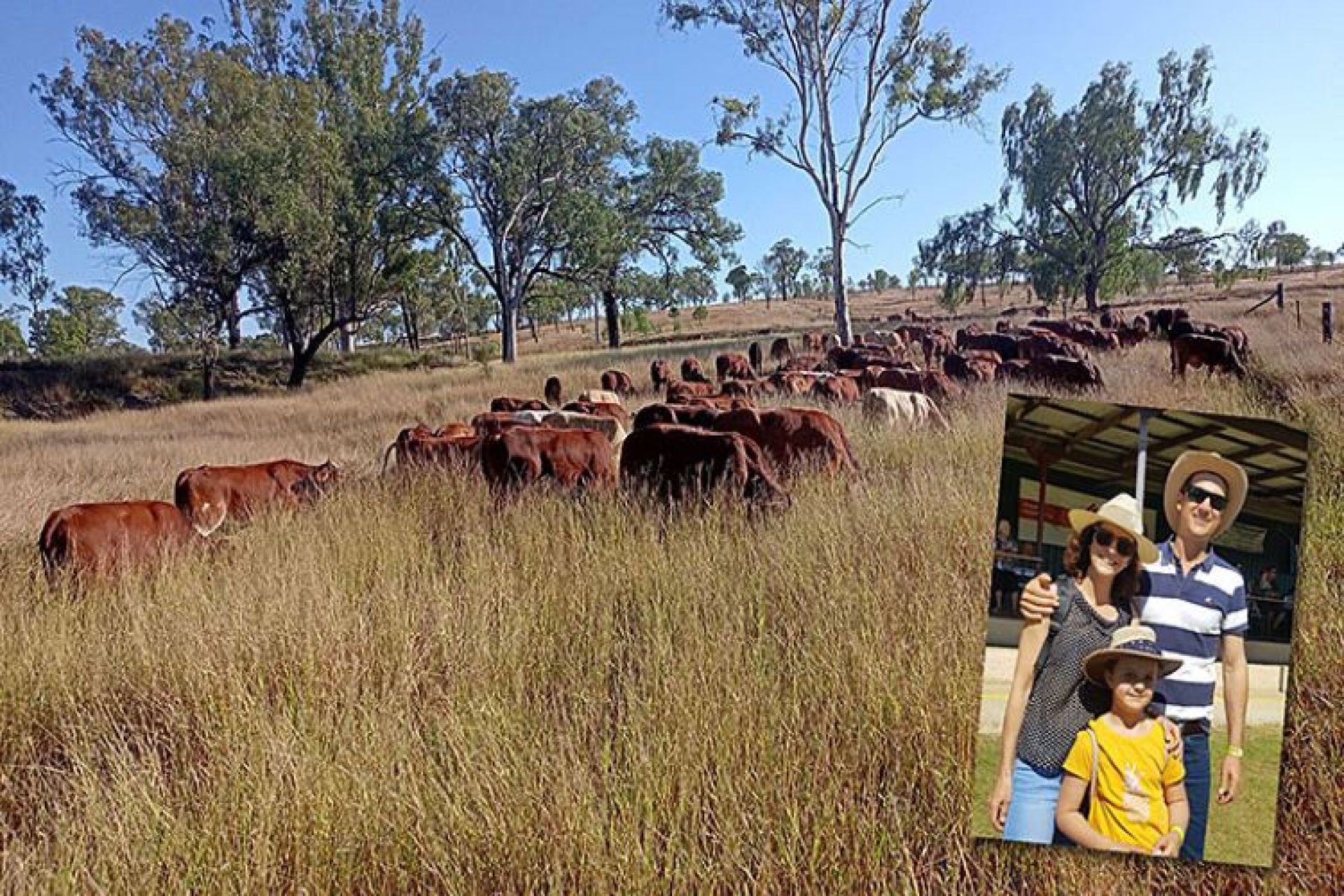
Stuart and Katie Barrett know the importance of working with the land to not only help it sustain their lifestyle but also ensure its environmental viability into the future.
The couple run Drumburle in Thangool which runs about 600 breeders across 6,500 hectares (ha), with an additional 800ha at Lawgi Station, seasonally mating a mainly Droughtmaster herd.
European Union (EU) accredited steers are grown out to feeder weight on leucaena at Lawgi Station, to then sell to Mort & Co. Cull heifers and cows are fattened on Lawgi and marketed to Teys Biloela on the grass EU grid.
The European Union Cattle Accreditation Scheme (EUCAS) is a national animal production scheme that guarantees full traceability of all animals through the National Livestock Identification System (NLIS), linking individual animal identification to a central database.
EUCAS allows Australia to meet the EU market requirements for beef by segregating cattle that have never been treated with hormonal growth promotants (HGPs) at any time.
The Barrett's heightened focus on sustainability is seen in other areas as well including ease of management in fencing and paddock design, plus nutrition, fertility and genetics.
A history of change
The property has been in the family since drawing the original Peppercorn lease in 1875. Mr Barrett said the operation had gone through many transformations.
"It's had sheep and it's done draught horse production for the sugar mills, but in the last 3 generations it's been just solid beef production," he said. "And mostly in the last 2 generations it's been beef breeding, so it's used as a calf factory."
"Having had 5 generations run through, it's fairly obvious that we're doing something right, and what we're doing has to be sustainable because we're still here, we're still in business, and the land's still looking pretty reasonable." Mr Barrett said there were things he needed to do in his generation's drive to build the business further.
"Things like laneways and fences, ensuring ease of stock management, and the all-important elements of nutrition, fertility and genetics, as well as the hard slog of development and maintenance," he said.
Recognising the importance of human resources and cultivating strong relationships was also necessary, according to Mr Barrett. "So much of the management puzzle is knowledge, so it's important to have those relationships with people outside of your business," he said.
The Barretts obtained EU accreditation in 2012.
"Originally, I was trying to sell finished animals—heifers and steers—into Rockhampton when Biloela wasn't EU accredited, but it wasn't really working because I didn't have enough pasture to get them all through, the seasonality was just too tough, so I knocked it back a notch," he said.
Grazing resilience
Mr Barrett is always looking for ways to improve his grazing business and contacted the department's beef extension team to find out about the Grazing Resilience and Sustainable Solutions (GRASS) program.
The GRASS program supports graziers in the Burdekin, Fitzroy and Burnett Mary regions with areas of poor or degraded land condition to develop and implement a tailor-made action plan for land management. This plan helps graziers improve their productivity while helping protect the reef by reducing soil loss from properties and supporting jobs and services in the cattle grazing sector.
Mr Barrett said the GRASS program had been worthwhile and that by working through it, they had made improvements to ground cover in several paddocks throughout the property.
"GRASS was the catalyst for getting the department's soil scientists out here to give us a report on an area of erosion that we would like to repair. It also helped us understand our land types better and provided us with some excellent maps of land types as well as full, large-scale, laminated property maps with imagery and infrastructure," he said.
"The best thing about GRASS was seeing that both big and small changes in grazing management can have effects on long-term ground cover, as GRASS provides historical data on ground cover for your property. So, although at times it needed some interpretation—say for areas of leucaena planting preparation that have been cultivated or bushfires that have gone through—it is really good to see positive groundcover changes over time," Mr Barrett said.
Northern Breeding Business (NB2)
Mr and Mrs Barrett are also involved in the Northern Breeding Business (NB2) program, which is funded by Meat and Livestock Australia and facilitated by the department. Mr Barrett is the producer coordinator for the Fitzroy NB2 group, which has 10 producer members located across the Fitzroy catchment.
NB2 is a collaborative research and adoption program exploring opportunities to:
- improve reproductive rates
- decrease mortality
- increase turn-off weights
- improve genetic potential in northern herds.
The core business of the NB2 program is built around 3 pillars supported by an integrated adoption and extension program:
- feed base pillar focuses on optimising feed production, supply and utilisation for the breeding herd to achieve target performance levels cost-effectively.
- herd management pillar focuses on enhancing breeding herd performance through improved systems and interventions.
- sustainability pillar explores issues related to managing the rangelands and the environment, and the long-term sustainability of the northern beef industry. This pillar aligns with the existing Australian Beef Sustainability Framework (ABSF). NB2 has adopted the ABSF definition of sustainability.
"The production of beef needs to be in a manner that is socially, environmentally and economically responsible. We do this through the care of natural resources, people and the community, the health and welfare of animals, and the drive for continuous improvement," Mr Barrett said.
Sustainable business and people
The business' heightened focus on sustainability is seen in other areas as well, including ease of management in fencing and paddock design, plus nutrition, fertility and genetics. Having watched his wife reskill from medicine and dealing with people, to running a rural operation, Mr Barrett has more insight into sustainability in terms of workforce.
"People are the main drivers of a business; they are probably the most overlooked asset in my opinion," Mr Barrett said. "If the business has the right people, it's unlikely to go too far wrong even in the most challenging of times.
"The labour or workforce shortage has seen many people from industries that have little to do with agriculture—retail and aviation for example—come into the agriculture workforce and employers are often surprised with the skills that these people bring that agriculture actually needs, for example, occupational health and safety, human resources, communications, compliance, data and financial management and analysis. While core or base skills may need developing in other areas, employers are well placed to gain if they can bring these other skills into their business," Mr Barrett said.
Being involved in projects like GRASS and NB2 has enabled the Barretts to attend extension events and training and focus on their business sustainability and profitability into the future. Working in a peer-to-peer group with NB2 has allowed them to bounce ideas off each other and work on their business resilience.
Working with other producers and learning from each other, together with the advice given by the department's extension team, is enabling the Barretts to make the most of the opportunities, care for their land, people and business and plan for the future.
Last updated: 22 May 2026