Exploring the Anderson family's 5-year AgTech plan, this cost benefit analysis highlights insights from the FarmTechConnect project.
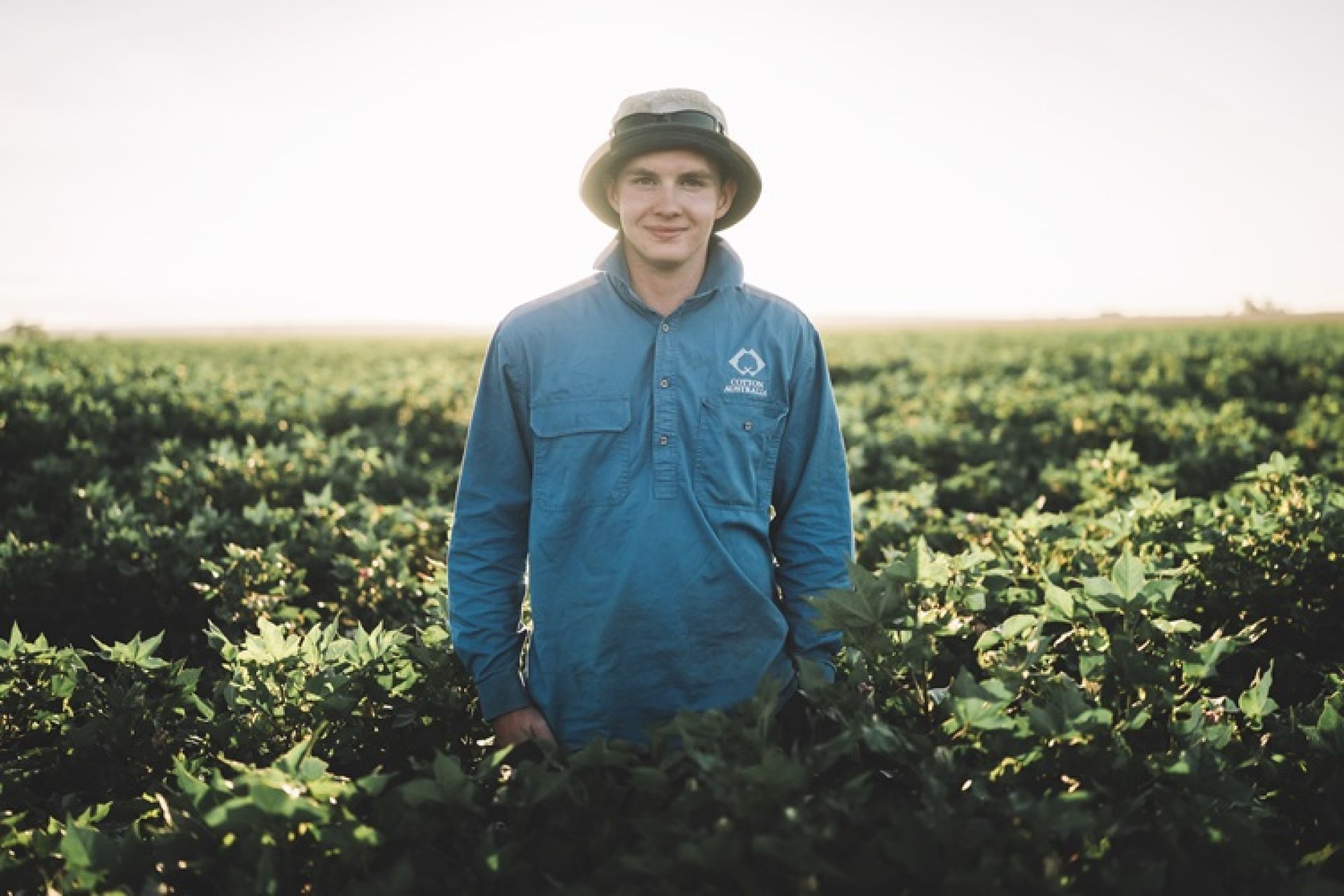
The Anderson family, based in Emerald, operate an irrigation and rain-fed cropping business on Kerry Downs and Quingilli.
Their home property, Kerry Downs, has considerable development and is fully under irrigation, while Quingilli is less developed (with area put aside for natural rewilding and biodiversity), using both irrigation and rain-fed systems.
The Andersons grow pulses, grains and cotton, with water sourced from the Fairbairn Irrigation Network.
Renée and her son Mitchell participated in the FarmTechConnect program to help better integrate AgTech solutions to their operations.
Read more about the Anderson family's experience with the FarmTechConnect program.
The Andersons are focused on sustainability in their business and the broader industry. Their business operates on a low input cost and high margin basis, focusing on profitability. The Anderson family have already adopted several AgTech tools, including weather stations, moisture probes and canopy sensors for irrigation monitoring, and variable rate fertiliser systems. They use in-tractor screens and management software for data collection and Xero for financials. They also utilise satellite data and NDVI maps from various sources.
However, data from various platforms doesn't always communicate effectively and manual integration is time-consuming, especially for compliance certification systems. Like many producers, they have also experienced difficulty in accessing adequate support from technology solutions providers.
The Andersons are a good example of a business where tech savvy children are transitioning from school to full-time engagement in the farming business and bring with them a different set of skills and viewpoints. The Andersons are keen to ensure both the boys can contribute to the family business in a meaningful way, which makes the most of their unique, next generation talents.
AgTech solution: Farm Management Software
The Anderson family is pursuing the adoption of Farm Management Software ($2,795 per annum) among several other items in their 5-year AgTech adoption plan.
This is anticipated to require 20 hours of labour to set up in the first year and 5 hours per year thereafter at a cost of $110/hr, being $2,200 and $550 per annum, respectively.
For the purposes of this analysis, it has been assumed that this management system will operate for 5 years, at which point it may no longer be functioning and have no commercial value, with a total cost of $18,375.
Benefits
There are 3 main financial benefits from this AgTech adoption – labour savings, reduced pest management costs, and increased crop production with a better pest management system.
Currently, the labour spent on best management practices and Better Cotton Initiative (BCI) recording and reporting requires about 2 hours per week and 20 hours per annum. At $110/hr this costs $13,640 per annum.
Adopting this AgTech can streamline operations, reducing the required time to one hour per week or $5,720 per annum, a saving of $7,920 per annum. Better information about past spray operations and electronic chemical record keeping, will eliminate unnecessary sprays and time spent on spray decisions. This improvement is estimated to be a saving of 25 hrs/month or $33,000 per annum. There will also be a saving from reducing machinery costs.
Th AgTech adoption is expected to reduce spraying operations by 35 hr/per annum which reduces operational costing relative to fuel, oil and repair and maintenance costs ($70/hr), resulting in a saving to the Andersons of $2,450 per annum.
A 10% reduction in chemical costs is also expected. This will be a saving of $15,000 per annum. The total saving of pest management is $48,000 per annum. Improved chemical record-keeping and more informed spray decisions are anticipated to enhance crop growth by 10%, driven by better water use efficiency. While this is expected to increase crop production variable costs by 2.5%, it would still result in a 7.5% increase in crop gross margins, totalling $262,500 per annum. This is a total saving of $318,420 per annum from AgTech adoption.
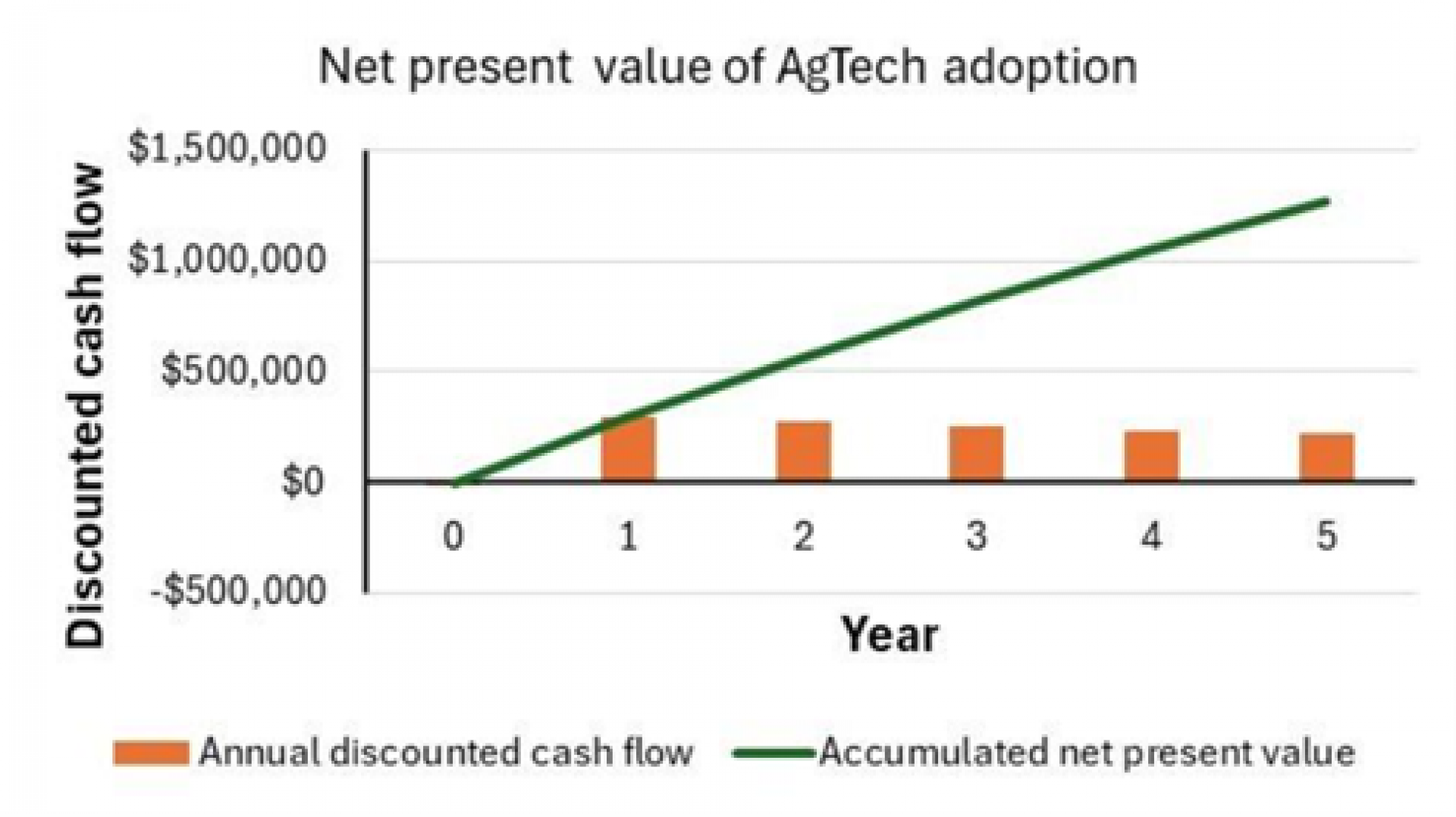
There are a few economic metrics that can be used to evaluate investment decisions, including
- return on investment (ROI)
- discounted net present values (NPV)
- payback periods.
The ROI of this AgTech adoption is 17,229% over a 5-year period, meaning that by the end of the period the grower will receive $177.23 for every dollar invested.
When evaluating long-term investments, it is essential to account for the time value-of-money as a dollar received in 10 years holds less value than a dollar received today due to factors such as inflation and the risk of non-receipt.
To reflect this, we have used a discounted rate of 7% per annum to future incomes to calculate the NPV of $1,272,159.
This figure represents the net increase in wealth generated over the 5-year period. The payback period of this AgTech investment, including bank loan costs of 8% per annum, was less than a year.
Additional benefits to producers
There are additional benefits to the Anderson family that are difficult to quantify. This includes reducing the stress of better farm management decisions and reduced environmental impacts from improved sustainable cropping. This personal utility is estimated to be valued at $5,000 per annum, increasing the ROI to 17,501% and the NPV to $1,292,374.
This cost benefit analysis was undertaken by the Department of Primary Industries and the producer participant using real life data.
Find out more
Find out how AgTech could help your business or email the Central Queensland Smart Cropping Centre at cqscc@dpi.qld.gov.au.
Last updated: 12 Oct 2026