From drone-to-tractor tech that helps kill weeds to keeping a digital eye on cattle in hard-to-reach places, InFarm is a Queensland company that's using AI and advanced technologies to help farmers be more productive and efficient.
"If you could solve weeds, that would be a good start"
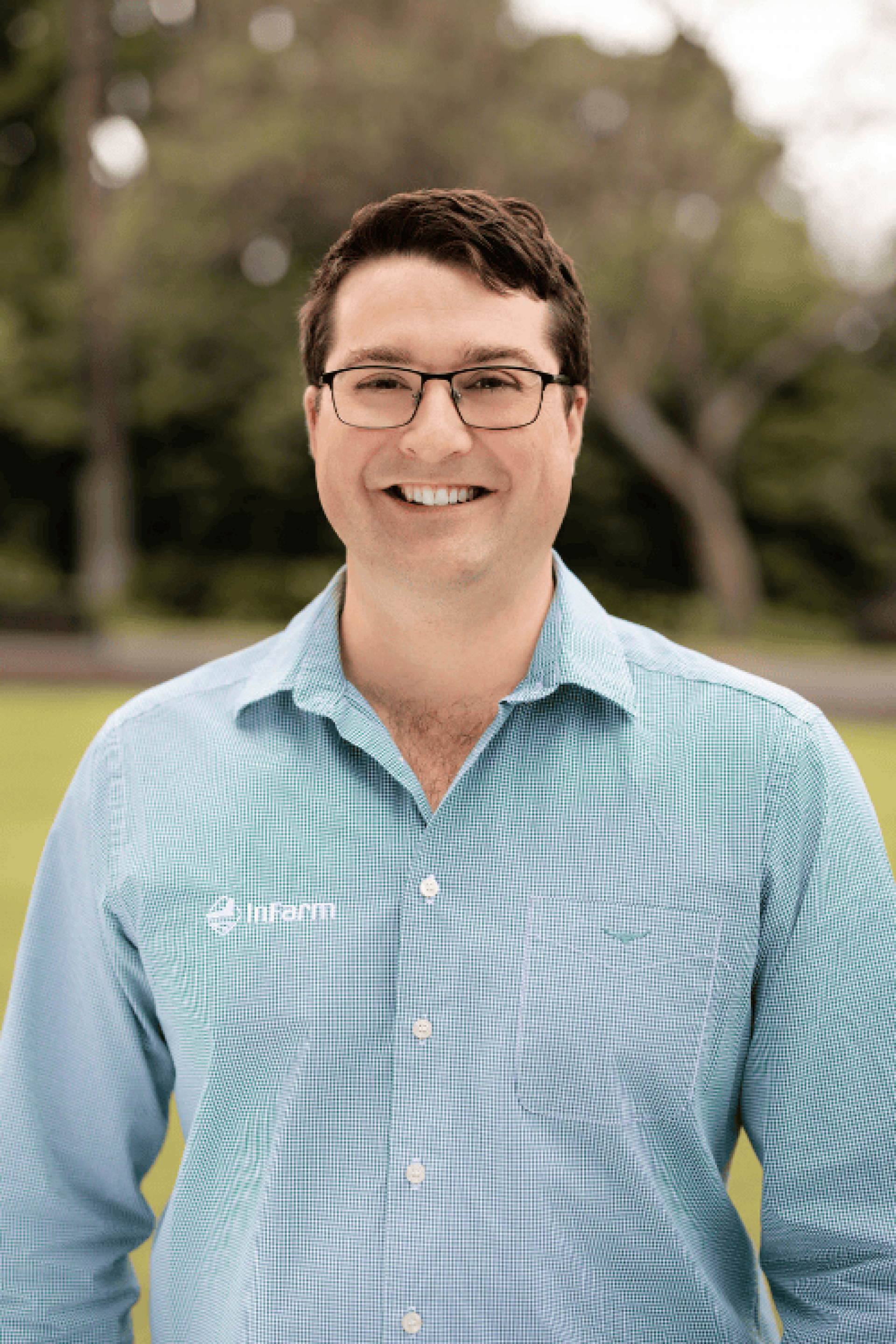
Jerome Leray has always had a connection with farming, and a drive to solve the challenges farmers face. It started with a childhood dream to own a property.
"As a kid I went and visited a big station and decided then that I was going to own a farm. Over the years, I asked local farmers questions like, what would move the dial to save you (as growers) or make you money. And they said 'if you could solve weeds, that would be a good start'," Jerome said.
These conversations sparked a drive in him to solve farming challenges that has stayed with him ever since.
He founded InFarm to focus on delivering ground-breaking technology to farmers. They use state of the art Artificial Intelligence (AI) and advanced technology to develop tools that help farmers make better decisions to become more profitable, efficient and environmentally sustainable.
One of their best-known technologies is an internationally acclaimed weed detection platform. The drone-to-tractor solution integrates with everyday tractors to target weeds.
Farmers don't need any new hardware to use the platform — it leverages the systems they already have and saves up to 97.5% in herbicides.
For Jerome, InFarm's early success in weed control technology opened up a world of possibility for what else could be done to help farmers.
Digital eyes to boost productivity for Queensland producers
Jerome's focus has since broadened to tackle the challenges faced by northern Australia’s beef industry.
Almost half of Australia's cattle comes from this northern region. Cattle stations here are enormous and remote, and vast distances between infrastructure means limited to no connectivity. Combined with a hot, wet climate and restricted seasonal access, monitoring a herd is logistically difficult to say the least.
Cattle also have lower fertility rates than in other parts of the country, due in part to the climate and genetic selection.
"Imagine if every time a cow came to a watering point in this challenging environment it could be observed. We wanted to develop a solution that could monitor a herd for greater animal husbandry outcomes and for production performance," Jerome said.
InFarm and our AgTech scientists joined forces to embark on an exciting collaboration to tackle these big challenges.
We worked together to develop a camera system and an app that use AI and machine learning to locate, identify and monitor cattle.
"This technology has digital eyes on your animals at all times, even in locations with limited connectivity."
The system's first job was to identify cows and calves, to give producers information to help them combat low fertility rates in extensive beef herds.
To do this, it uses edge-computing hardware and AI modelling for automated, high-quality image and data capture, and analysis.
Our team, led by Principal Scientist Paul Stewart, facilitated the system’s trial at our Brian Pastures Research Facility (near Gayndah) where more than 86,000 videos and 750,000 images of cows and calves were captured to train the AI.
Think Digital joined in on the collaboration to help develop a phone app and refine the system's AI capabilities. From there, we developed the system further into remote surveillance nodes that can look for things like animal injuries and lameness, signs of emergency animal disease and other production issues.
The data captured by the camera hardware is automatically analysed to identify potential signs based on parameters like skin lesions, changes in behaviour, body condition and specific clinical signs.
"The app puts a surveillance tool in every producer's hand, with the added benefit of a decision-making tool for endemic problems like cattle tick and buffalo fly," Paul said.
"Another huge benefit is that the surveillance nodes can do everything remotely, eliminating the need to be there in person to monitor the herd. It only sends alerts when it identifies an issue the producer needs to address, which significantly reduces the level of connectivity needed in remote locations."
The cameras have also spotted other animals like feral pigs, cats, birds, kangaroos, wallabies and elusive bettongs, pointing to a potential way to monitor feral and native animal numbers.
Contact
Email DPIAgTech@dpi.qld.gov.au
Last updated: 09 Oct 2026