In the heart of Central Queensland, Nigel and Beth Burnett are driving agricultural innovation, transforming their business, Colorada Cotton, with the help of cutting-edge AgTech solutions.
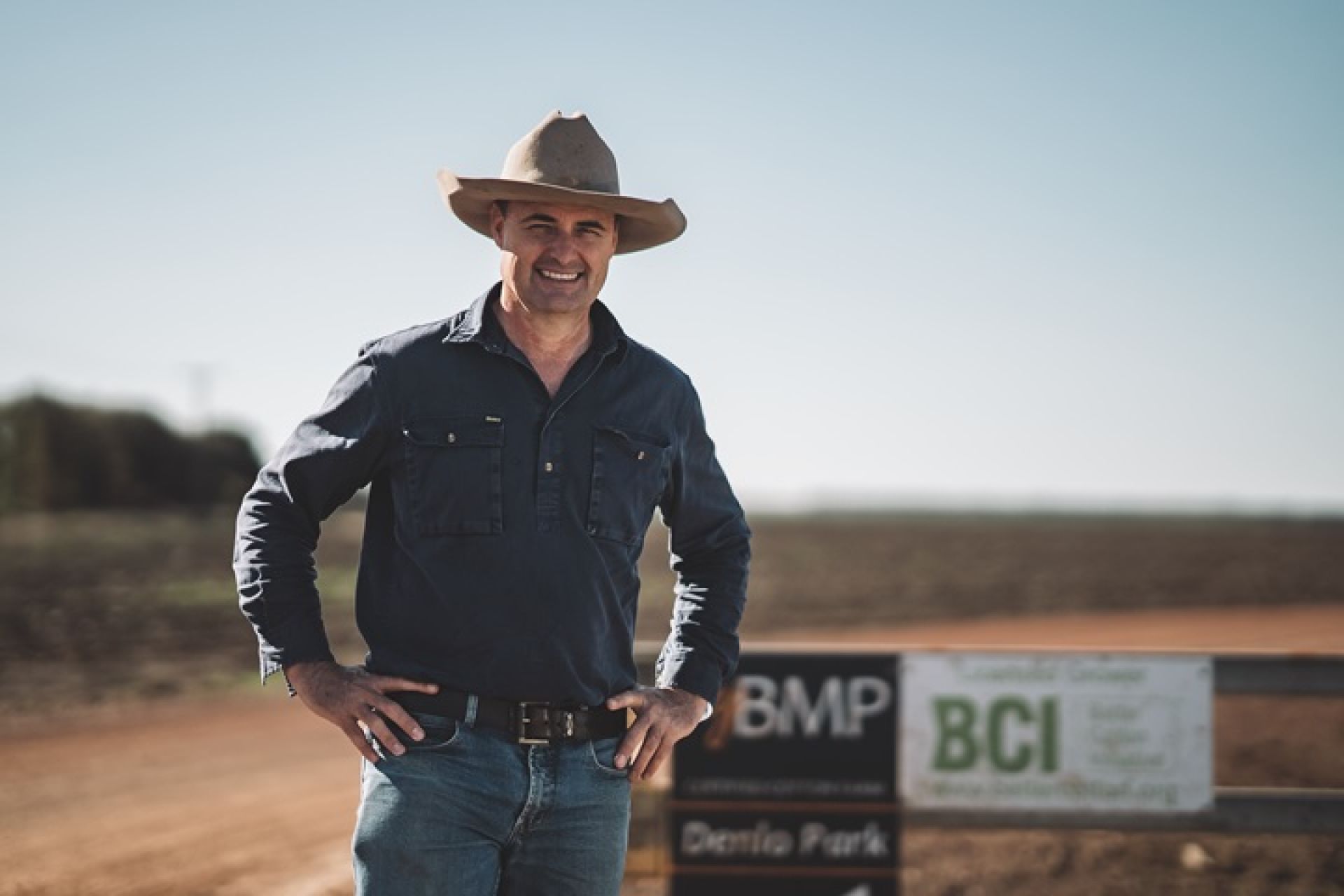
Based in Emerald, their 8,000-hectare (ha) operation is strategically diversified across 2 distinct farm management units:
- Denlo Park and Cedar Park near Springsure, and
- Colorada and Langley Downs, situated north-east of Emerald.
This geographical spread and integration of diverse farming systems are integral to their risk mitigation strategy, enhancing the resilience of their business.
While cotton forms the cornerstone of Colorada Cotton's activities, they also grow a range of irrigated and rain-fed crops in rotation, including wheat, sorghum and chickpeas.
Nigel also maintains an additional diversification in revenue stream with a 2,000 ha beef production operation at Langley Downs.
Forward-thinking operators embracing AgTech
Nigel takes a proactive approach to farm management, consistently seeking opportunities to enhance their business through innovation. He recognises the transformative potential of AgTech to optimise his diverse cropping operations and drive improvements in efficiency across the board.
Nigel's participation in the department's FarmTechConnect pilot project underscores his commitment to exploring and adopting cutting-edge solutions that can effectively address the multifaceted challenges of managing a large-scale agricultural enterprise spanning multiple locations.
While Nigel understands that the acceleration of AgTech adoption is key to the long-term success of his primary production business, he has felt overwhelmed by identifying solutions that effectively address his needs, assessing their suitability and return on investment (ROI), resolving connectivity challenges, and knowing who to turn to for trusted advice. Many producers across Central Queensland share Nigel's experience.
Seeking integrated solutions for diverse operations
The complexity of managing operations across multiple properties and a variety of crops has led Nigel to seek AgTech solutions that offer a holistic, integrated view of their entire business.
A key priority for Colorada Cotton is the seamless integration of data from disparate sources to inform critical decision-making, especially when it comes to planting, irrigation scheduling, pest management, soil health and harvesting.
Nigel is particularly interested in tools that can streamline management workflows, optimise resource allocation, and ultimately contribute to enhanced productivity and profitability across their diverse cropping systems.
Nigel is focused on the interoperability of AgTech solutions to deliver better outcomes for decision-making.
"There's a need for an overall AgTech strategy for our business. That broader view."
About FarmTechConnect
FarmTechConnect was a 9-month pilot program helping producers like Nigel assess AgTech and connectivity options to improve their businesses.
It included:
- one-on-one farm visits and interactive digital workbooks
- risk and ROI assessments
- skill-building in tech and connectivity
- attendance at leading AgTech events such as AGTECH 2024, Queensland AgTech Summit and evokeAG 2025
- peer learning and development of a 5-year AgTech adoption plan.
Show transcript
Narrator: Nigel and Beth Burnett operate 4 properties across 2 farm management units: Colorada and Langley Downs near Emerald, and further south, Cedar Park and Denlo Park near Springsure.
Nigel Burnett (Colorada Cotton): We’re really fortunate to have a strong management structure within our organisation. We’ve grown in the last 8 years to a point where I couldn’t do it all on my own. I needed to have really good management people and be able to trust those people to deliver on our strategy and on the production system that we require. It’s been a really rewarding and productive time for us, and our business has grown in a really strong way as well.
Narrator: This primary production business is mainly focused on irrigated and rainfed cropping and cotton systems, with an additional beef operation at Langley Downs. While Nigel has experienced managers at each unit, he largely services the beef business himself.
Nigel Burnett (Colorada Cotton): The cattle business is a smaller part of our entire business. We’re currently grazing 2,000 hectares of grass country for our cattle. It takes up a much smaller part of our time compared to what we do with our irrigated cotton country and our dryland farming country as well. I think it’s probably where some of the biggest gains can be had in this AgTech space for us.
Narrator: Key pain points include irrigation scheduling and management, a desire to enhance soil health with support from his agronomist, servicing the livestock and water monitoring, and the need for greater interoperability between AgTech tools across machinery and in-field devices.
Nigel Burnett (Colorada Cotton): It can be confusing and a little bit frustrating as well because the technology keeps evolving and moving on once you've made your purchase. The variety of AgTech out there to address a pain point is really, really broad, so it takes a lot of time to do the due diligence on that. And I guess that’s frustrating for someone like myself who doesn’t have a whole heap of time.
Narrator: Managing 2 farm units has highlighted the importance of data integration and a streamlined way to make data-driven decisions, especially with Nigel’s broader industry commitments.
Nigel Burnett (Colorada Cotton): The expertise out there and the support of what is available has been really limiting. And that’s what I think this project is going to really give us, the ability to access those people who can give us experience. They have broad contact across the industry, and they understand what's working and also what's coming as well. And that's one of the bigger things that I am looking forward to as part of this project.
Narrator: As the current chair of Cotton Australia, Nigel balances major leadership responsibilities alongside his farming role. While he enjoys checking in on the cattle, he knows it’s a major draw on his limited time.
Nigel Burnett (Colorada Cotton): It’d be great to do that remotely, particularly if I’m in Canberra doing industry work… to check in on the waters, make sure the cattle are in good shape and ensure there are no issues with our watering system.
Narrator: To better manage his beef enterprise, Nigel is planning to install tank and trough monitors, alongside a camera surveillance system for remote observation and security. He’s also planning to adopt in-paddock weighing for continuous mob-based monitoring.
Nigel Burnett (Colorada Cotton): For our business, it’d be that ability to manage our mobs better, you know, and understand the foraging data side, to make sure we can make more informed, data-driven decisions on the selling of that cattle.
Narrator: A cost-benefit analysis conducted by a Department of Primary Industries Senior Economist suggests significant financial returns for Nigel’s beef business. Remote monitoring of water and livestock, coupled with the implementation of an in-paddock weighing system, is anticipated to deliver savings of more than $400,000 per annum. Collectively, the adoption of these solutions over 10 years represents an ROI of more than 2,500 per cent.
Participating in the FarmTechConnect pilot project has assisted Nigel in tackling connectivity challenges for AgTech functionality and interpersonal connections.
Nigel Burnett (Colorada Cotton): I didn’t realise this was going to be the exciting part, but once we got in the room with the other participants, hearing their stories and the opportunity to learn from them, and also be part of their journey, was really valuable. I think that should help inform a lot of the challenges we’ve got and how we’re going to push through on our own farm.
Narrator: With a 5-year AgTech plan developed during the FarmTechConnect pilot, Nigel now has a clear roadmap for adoption.
Nigel Burnett (Colorada Cotton): We want to develop a dashboard to bring all that AgTech together so it really fits our management solution, the way we’ve got things set up. I need to have access to it all in one place, and I think that’s going to be really important coming out of this. It’s not just about actual AgTech solutions on farms, but bringing it all together so we can run our business in a better space.
Narrator: Through the FarmTechConnect pilot, Nigel Burnett has moved from complexity to clarity, building confidence in his technology choices.
Nigel Burnett (Colorada Cotton): I think AgTech has always been, for me, like that next bridge. You know, we know what we’ve done for the last 20 years on the farm, and it’s actually a really good recipe; it’s worked really well for us. But I think AgTech is about taking things to the next level for us.
You can build a plan, but it means nothing without action. And so we’ve got our plan in place now, we can really look at the solution side and work out how we might resource that. For me, as I mentioned before about wasting money, it’s really important, the way we run our business, every decision is made with a lot of due diligence and research. That’s what this part of the process has been, and now it’s time to start making some changes on the farm by investing in this technology.
Narrator: Agriculture is evolving, and so are Central Queensland farmers. Visit Queensland DPI’s AgTech website to learn more and get involved.
Key challenges and opportunities for Colorada Cotton
Colorada Cotton faces a range of challenges and is pursuing several opportunities where AgTech could make a significant impact.
- Disparate data without aggregation: Nigel recognises that while he already collects a significant amount of data, it is stored in disparate locations and is not yet integrated into a data-driven decision-making process. He has identified the need for a unified platform to view data and derive actionable insights across agronomy, financials, production, inventory, biosecurity, and fuel and input management.
- Agronomy optimisation: There is a focus on developing a soil health strategy and leveraging AgTech to support this, along with improving collaboration between staff and agronomists.
- Input management: Nigel aims to track and manage inputs more effectively across both farm management units and to integrate this data with financial records.
- Irrigation efficiency: At Denlo Park and Cedar Park, there is a need for more real-time information for main channel level monitoring and tailwater sensing. Additionally, remote monitoring of pump performance, particularly on the black soil in wet conditions, a desire for remote automated pump control.
- Connectivity: Poor 4G/5G connectivity is a limitation across both locations.
- Beef operations at Langley Downs: Nigel has identified a need for increased focus on this aspect of their operations, particularly around pasture and cattle performance, and a significant portion of his time is spent checking waters and mustering.
Reflections and future directions
With a 5-year plan for AgTech adoption, Colorada Cotton is focused on the following areas.
Business
- Centralised data dashboard: A customised system to consolidate and visualise the relevant data for decision-making across the whole enterprise.
- Integrated Farm Management System: Software for comprehensive farm, financial, inventory and machinery management across both farm management units. The focus is on aggregating existing data sources and collaborating with their agronomist.
- Soil monitoring: Devices to measure soil moisture, temperature and electrical conductivity for informed crop management, with a product trial already underway in conjunction with the Central Queensland Smart Cropping Centre.
- Satellite mapping: Access to tools for monitoring, management and precision agronomy, including basic Normalised Difference Vegetation Index (NDVI) data, to be deployed across both farming and pastures.
Farming
- Water monitoring: Tailwater and channel sensors to track water levels for efficient management and analysis.
- Pump performance monitoring and operations: Systems to remotely monitor and operate irrigation pump metrics like oil pressure, revolutions per minute (RPM) and temperature for key assets.
- Inventory management: Solutions for tracking fuel and other product usage, and grain inventory management for on-farm storage and marketing logistics.
- Digital weather station: Environmental data for improved livestock and cropping decisions, and record keeping.
Connectivity is everything, and terrain matters
Colorada and Langley Downs are positioned where fixed wireless is available as a backhaul option, as well as an existing remote-area satellite internet service located in the staff accommodation. Either connection could be leveraged using high-gain WiFi hotspots around the workshop/shed/house precinct to provide better connectivity.
At Langley Downs, stock water monitoring is a key livestock husbandry practice that could be achieved either by implementing strategically placed solar-powered 4G LoRaWAN gateways connected to monitoring nodes or by using satellite-connected monitoring devices. Either option will be effective, but ultimately the final decision will depend on the cost of implementation and ongoing subscriptions. Livestock weight monitoring is also a key opportunity, and from a connectivity point of view, a satellite-connected in-paddock weighing system is the best solution.
Due to poor mobile connectivity at both farm management units, Nigel and his team must leave the sheds and climb an embankment to get enough signal to make a phone call, frequently experiencing service interruptions. This leads to safety concerns and impaired operational efficiency.
A satellite internet service has been used on a limited scale at Denlo Park, installed on nearby staff accommodation.
This service is the only viable backhaul option that could be leveraged by:
- using high-gain WiFi hotspots around the workshop to provide better user connectivity
- installing smaller, portable antenna units that can be moved between 4WD, tractors, spray rigs and cotton pickers.
LoRaWAN technology could also be implemented to enable AgTech solutions to monitor water storage, transfer pumps and channel levels.
Cost benefits: Where's the beef?
One key focus for improvement is the operational management of the beef livestock business at Langley Downs, which is largely serviced by Nigel.
Ensuring a consistent water supply and monitoring pasture and livestock weight gains and animal health are constantly on Nigel’s mind. He spends considerable time travelling to and from the cattle as well as making in-person visual observations and interventions.
Nigel is keen to immediately adopt remote tank and trough monitoring systems, solar-powered cameras for ground-truthing observation and security, as well as a mob-based in-paddock weighing system.
Water
While the initial investment for this setup is around $36,650 over a 10-year lifespan, the annual savings from reduced manual checks and improved water management are estimated to be $22,500. Additionally, ensuring a consistent water supply is projected to increase liveweight gain, adding a substantial $56,210 in annual benefits for a 400-head operation.
This translates to an impressive ROI of 2,048% over the decade and a Net Present Value (NPV) of $505,994, with the initial investment potentially paying back in less than a year, even with loan costs. Beyond the quantifiable financial gains, Nigel benefits from enhanced security, the ability to monitor cattle presence remotely, and increased peace of mind.
Livestock monitoring
Implementing an automated in-paddock monitoring system that leverages satellite technology to track individual cattle weights offers an opportunity to optimise liveweight gain. This solution requires an initial investment of $53,300 over 10 years, including the cost of attractants. The primary benefits stem from reduced manual cattle checks and mustering, saving approximately $14,250 annually.
More significantly, the ability to closely monitor weight gain allows for optimised feeding and management practices, potentially increasing liveweight gain efficiency and enabling a faster turnover of cattle.
For Nigel's 400-head operation, this improved efficiency is projected to generate an additional $135,905 in annual benefits. Consequently, this AgTech adoption boasts an even higher ROI of 2,723% over the 10 years and a substantial NPV of $987,631, again with a payback period of less than a year. By providing data-driven insights into cattle performance, this technology empowers Nigel to make more informed decisions, leading to significant improvements in productivity and profitability.
This cost-benefit analysis was undertaken by the department and the producer participant using real-life data.
Next steps
With a renewed enthusiasm and sense of direction for AgTech adoption, Nigel is motivated to take action on his plan as soon as possible. He has already taken steps to order his new AgTech and upgrade his connectivity. He is also participating in a field trial in collaboration with a crop sensor tech provider and the Central Queensland Smart Cropping Centre to help other producers see AgTech in action and consider the benefits for their operations.
Nigel actively participated in the FarmTechConnect pilot project, engaging in workshops and collaborating with tech experts. He found significant value in the opportunity to connect and share experiences with other producers navigating similar AgTech adoption journeys.
“I didn't realise this was going to be the exciting part, but once I was in the room with the other participants, hearing their stories and having the opportunity to learn from them and be part of their journey. I think it's helped me understand some of the challenges we're facing and how we can overcome them on our own farm,” says Nigel.
Learn more
View the detailed cost-benefit analysis of Colorada Cotton.
Find out how AgTech could help your business or email the Central Queensland Smart Cropping Centre at cqscc@dpi.qld.gov.au.
Last updated: 12 Oct 2026