This cost-benefit analysis explores 2 AgTech solutions in Colorada Cotton's 5-year AgTech plan from the FarmTechConnect pilot project.

Nigel and Beth Burnett are the driving force behind Colorada Cotton, an agricultural business headquartered in Emerald, Central Queensland.
Their collective 8,000-hectare (ha) operation is strategically diversified across 2 distinct farm management units:
- Denlo Park and Cedar Park near Springsure, and
- Colorada and Langley Downs, situated north-east of Emerald.
This geographical spread and the integration of diverse farming systems are integral to their risk mitigation strategy, enhancing the resilience of their overall business.
While cotton forms a cornerstone of Colorada Cotton's activities, they also grow a range of irrigated and rain-fed crops in rotation, including wheat, sorghum and chickpeas. Nigel also maintains an additional diversification in revenue stream with a 2,000 ha beef production operation located at Langley Downs.
Read more about Nigel's experience with the FarmTechConnect program.
AgTech solution: Remote water monitoring and surveillance
Inspecting watering points to ensure livestock have sufficient water is time-consuming but necessary to ensure good animal husbandry and cattle performance (liveweight gain).
One AgTech option is to remotely monitor watering points and cattle with:
- 4 tank level sensor units (cost $7501ea + $65ea p.a.)
- 2 trough level sensors (cost $750ea + $65 p.a.)
- 4 solar-powered long-range wide area networks for connectivity ($2,500ea)
- a solar-powered camera (cost $6,500ea + $120 p.a.), and
- a software dashboard (cost $500).
It is expected that this equipment will last 10 years, at which point the equipment will no longer be functioning and have no commercial value, with a total cost of $36,650.
Benefits
There are 2 main financial benefits from this AgTech adoption:
- savings from reduced physical water checks, and
- improved livestock production.
The following values are based on the grower's estimates. It currently takes about 5 hours a week to check watering points, costing $150/hr based on earning capacity elsewhere in the business. This is an annual cost of $39,000 p.a. With the AgTech adoption for remote water monitoring, producers can halve the frequency of physical checks, reducing costs to $19,500 p.a.
Additionally, water management costs will be reduced by 20 hrs p.a, saving an additional $3,000 p.a. The cattle enterprise background is 400 head, and by ensuring cattle always have sufficient water, producers can boost liveweight gain efficiency by an expected 0.1 kg/head/day. At a liveweight price of $3.85/kg, this equates to an annual benefit of $56,210. Combined with the $19,500 saved from reduced water-checking time, the total annual benefit of adopting this AgTech solution amounts to $78,710.
Economic cost-benefit analysis
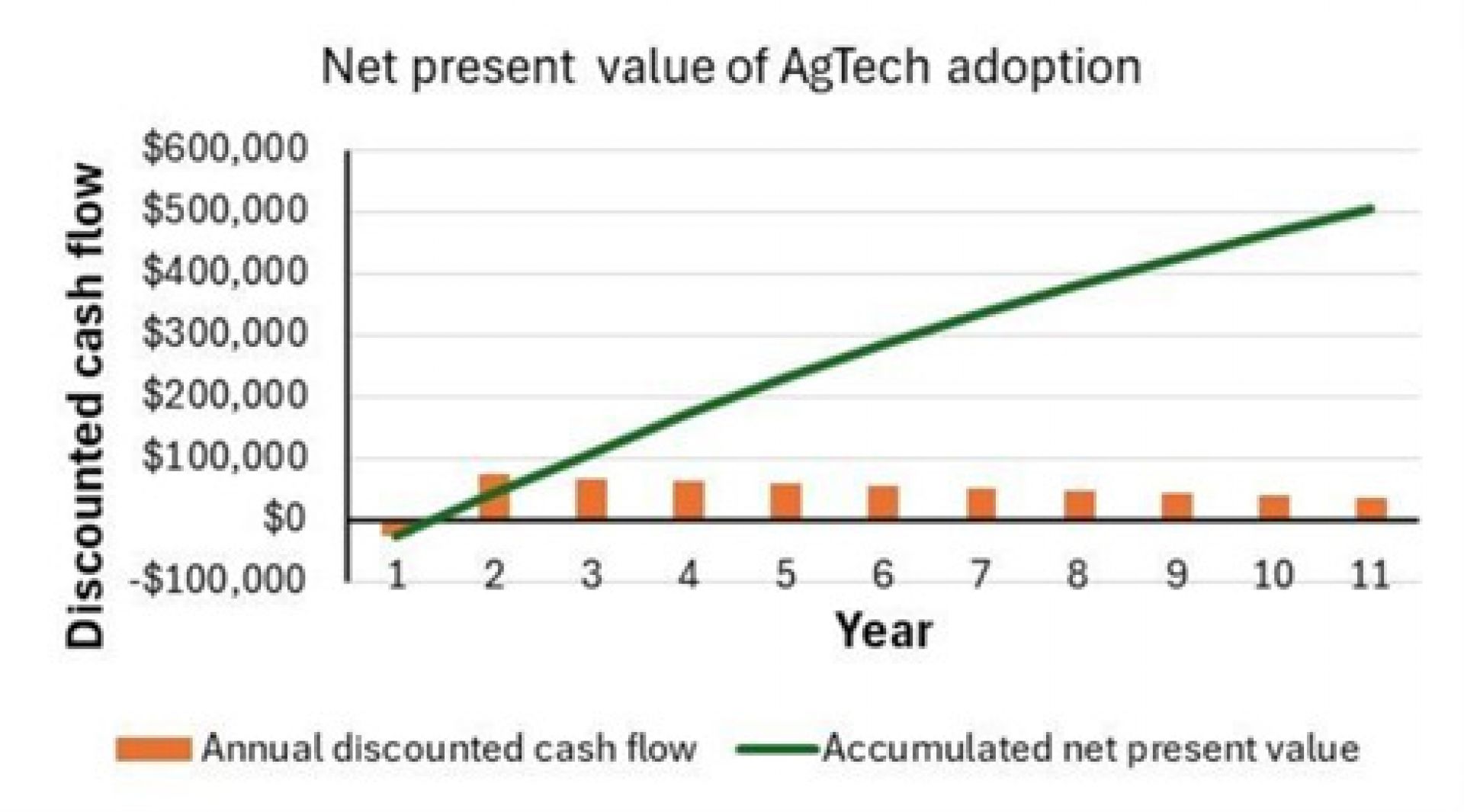
There are a few economic metrics that can be used to evaluate investment decisions, including:
- return on investment (ROI)
- discounted net present value (NPV), and
- payback periods.
The ROI of this AgTech adoption is 2,048% over 10 years, meaning the grower will receive $20.48 for every dollar invested.
For long-term investments, it is essential to account for the time value of money, as a dollar received in 10 years is worth less than a dollar received today due to inflation and risk.
To address this, a discounted rate of 7% p.a. was applied to future incomes, resulting in an NPV of $505,994. This represents the total increase in wealth over the 10 years.
The payback period of this AgTech investment, including bank loan costs of 8% p.a., was less than a year.
Additional benefits to the producer
There are additional benefits to the producer that are difficult to quantify. The camera monitoring can also be used to check the presence of cattle and adds security. It also provides the producer with peace of mind that they can leave the property and travel, while still being able to remotely monitor the water and organise repairs by a third party if needed. There is even the benefit of just being able to sleep at night knowing the cattle are watered.
This personal utility is estimated to be $20,000 p.a. This increases the ROI to 2,684% and the NPV to $643,930. Another benefit not included in the analysis is the weather station, which can improve farm management decisions for both livestock and broadacre cropping decisions.
AgTech solution: In-paddock liveweight monitoring
Another AgTech solution involves monitoring cattle liveweight gain over time using a mob-based in-paddock weighing system with satellite connectivity. This system costs $18,500 with an additional annual expense of $360 for connectivity and $3,120 p.a. for attractants to draw cattle to the unit. The equipment is expected to have a lifespan of 10 years, at which point it will no longer function or hold any commercial value, resulting in a total investment of $53,300.
Benefits
There are 2 main financial benefits from this AgTech adoption, which are:
- the savings in physically checking cattle, and
- improved livestock production.
The following values are based on the grower's estimates. It currently takes about 2.5 hrs per week to check on cattle, costing $150/hr based on earning capacity elsewhere in the business. This is an annual cost of $19,500 p.a.
With the AgTech adoption, where cattle can be monitored remotely (almost daily), cattle need only to be physically checked every second week, reducing the costs by $9,450 p.a. Additionally, cattle are mustered 4 times a year, costing $200/hr with an offsider. This takes 1.5 days each time at $9,600 p.a, with the in-paddock weighing unit. This only needs to be done twice a year, with a saving of $4,800/p.a.
The cattle enterprise operates as a backgrounding operation with 400 head. By ensuring the cattle always have sufficient feed, nutrients and remain healthy, the liveweight gain efficiency is expected to increase by 0.05 kg/head/day. At a liveweight price of $3.85/kg, this equates to an annual benefit of $28,105.
The greatest benefit of an in-paddock weighing unit is increasing the turnover of cattle. At the moment, Nigel feels the cattle are held for too long (around 18 months). This is a liveweight gain efficiency of 0.384 kg/head/day2. With better monitoring and management, it is expected that cattle can be finished in 12 months, and liveweight gain efficiency is expected to increase to 0.575 kg/head/day at an annual benefit of $107,800. With both savings of time checking water and increased livestock production, the annual benefit of this AgTech adoption is $150,455/year.
Economic cost-benefit analysis
There are a few economic metrics that can be used to evaluate investment decisions, including:
- ROI,
- discounted NPV, and
- payback periods.
The ROI of this AgTech adoption is 2,723% over 10 years, meaning that by the end of the period, the grower will receive $27.23 for every dollar invested. With long-term investments, it is essential to account for the time value of money, as a dollar received in 10 years is worth less than a dollar received today due to inflation and the risk of non-payment. To address this, we have applied a discounted rate of 7% p.a. to future incomes, resulting in an NPV of $987,631. This figure represents the increase in wealth over the 10 years. The payback period for this AgTech investment, including bank loan costs of 8% p.a., was less than a year.
Additional benefits to the producer
This has not been included, as it is an estimated $5,000/p.a, it doesn't have a significant impact on the economic metrics.
This cost-benefit analysis was undertaken by the department and the producer participant using real-life data.
Learn more
View the Colorada Cotton case study and video.
Find out how AgTech could help your business or email the Central Queensland Smart Cropping Centre at cqscc@dpi.qld.gov.au.
Last updated: 12 Oct 2026