This project tests how different fertiliser levels affect banana crops and their environments in Queensland.
What we do
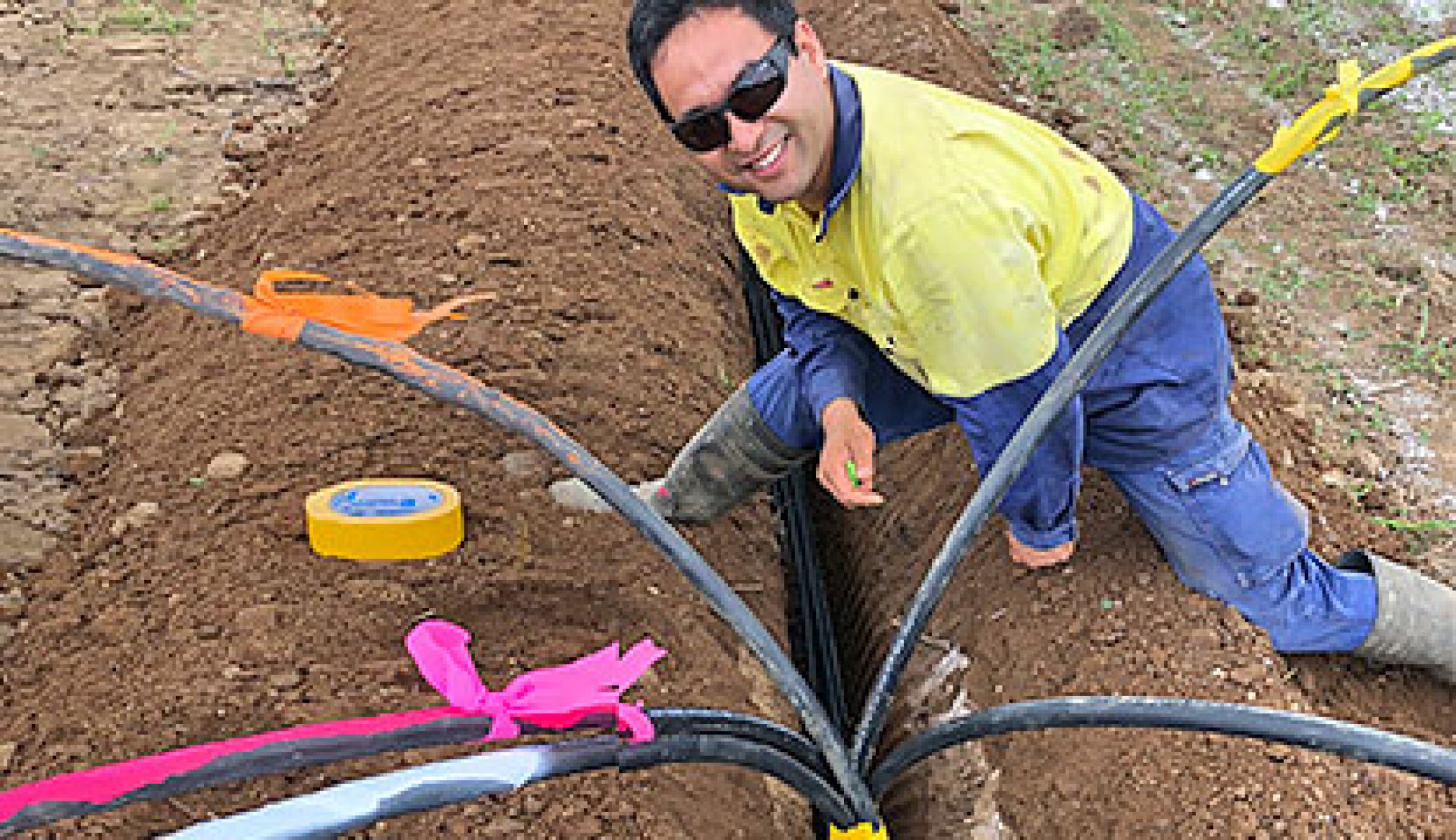
The banana nutrient trials are the second phase of a research project:
- investigating the rate of nitrogen and phosphorus fertiliser on banana productivity and profitability
- looking at associated environmental impacts.
Since 2019, trials have been established at:
- South Johnstone Research Facility
- commercial farms across the Wet Tropics region.
Each site has different soil types and crop management strategies, which influence nutrient management, including placement, timing and type of fertiliser, as well as the annual rate.
We deliver this project to support the Queensland Government's Reef Water Quality Program.
Our activities
In October 2023, we planted a new multi-rate factorial trial at the South Johnstone Research Facility to replace the original trial planted in 2019.
The new site is:
- fertilised using a custom-built, computerised fertigation system designed for commercial use
- larger, with more plants per plot
- planted at wider spacing.
We will:
- regularly collect soil and soil water samples to quantify the movement of fertiliser after application
- test 10 different rates of nitrogen and 4 different rates of phosphorus.
We also planted, managed and monitored 45 rows next to the rates trial to check the movement of nutrients, sediments and chemicals in overland flow and deep drainage. This is being studied by scientists from the Paddock to Reef Monitoring Program.
In November 2024, we planted an adjoining area to examine nutrient management factors, including:
- placement of fertiliser
- timing of fertiliser
- type of fertiliser.
This trial is being co-designed with industry and co-delivered with other Queensland Government agencies and will become a useful resource to support Banana Best Management Practices (BMP).
Benefits of the project
While improving productivity and profitability are core to the project, the environmental footprint of each trial treatment is also important. Regular monitoring of soil and soil water nitrogen levels will be integral to the project.
The overall aim of the project is to provide baseline information that can be used for modelling and estimating nutrient budgets under different scenarios. An added benefit of the trial is gaining an understanding of soil biological communities under different fertiliser regimes and collecting data that can be used to inform economic analysis.
The project will incorporate agri-technology to make results available to stakeholders in near real time.
The project will:
- improve understanding of phosphorus management to maximise banana crop productivity and minimise nutrient losses
- provide confidence to growers about adopting recommended nitrogen and phosphorus nutrient rates and BMP-endorsed fertiliser management practices
- provide information on improved nutrient use efficiency within banana cropping systems in North Queensland
- support banana BMP by providing information on productivity and creating sites that can be used for extension activities and communication.
What's next
The site was mounded and instrumented in October 2023, and a mixed-species fallow crop was planted.
In November 2024, we planted the new trial block after purchasing and installing an automated fertigation system.
The trial treatments were determined through consensus between our Project Reference Group members. The trial will compare sprinkler and drip irrigation against surface granular application, at different frequencies of application—monthly, fortnightly and twice-weekly.
We will also compare a nitrate-based program against the standard program centred on urea, and 2 enhanced-efficiency fertilisers.
Last updated: 22 May 2026