Species
- King threadfin (Polydactylus macrochir)
Fish stock status
Although a species may be classified as sustainable under the Status of Australian Fish Stocks (SAFS) framework, this does not mean that the stock is meeting Queensland targets under the harvest strategy.
| Stock | 2023 | 2020 | 2018 | 2016 | 2014 |
|---|---|---|---|---|---|
| Central East Coast | Sustainable | Not Assessed | Not Assessed | Not Assessed | Not Assessed |
| Far North East Coast | Undefined | Not Assessed | Not Assessed | Not Assessed | Not Assessed |
| Mackay East Coast | Sustainable | Not Assessed | Not Assessed | Not Assessed | Not Assessed |
| North East Coast | Sustainable | Not Assessed | Not Assessed | Not Assessed | Not Assessed |
| South East Coast | Sustainable | Not Assessed | Not Assessed | Not Assessed | Not Assessed |
| East Coast | Not Assessed | Sustainable | Sustainable | Sustainable | Not Assessed |
| Gulf of Carpentaria | Depleted | Depleting | Depleting | Transitional-depleting | Not Assessed |
Gulf of Carpentaria stock assessment
The 2024 stock assessment used current biological data, and commercial and recreational catch data to:
- determine the sustainability of fish stocks
- inform management decisions
- inform the development of a harvest strategy.
This assessment ran 8 scenarios, covering a range of modelling assumptions.
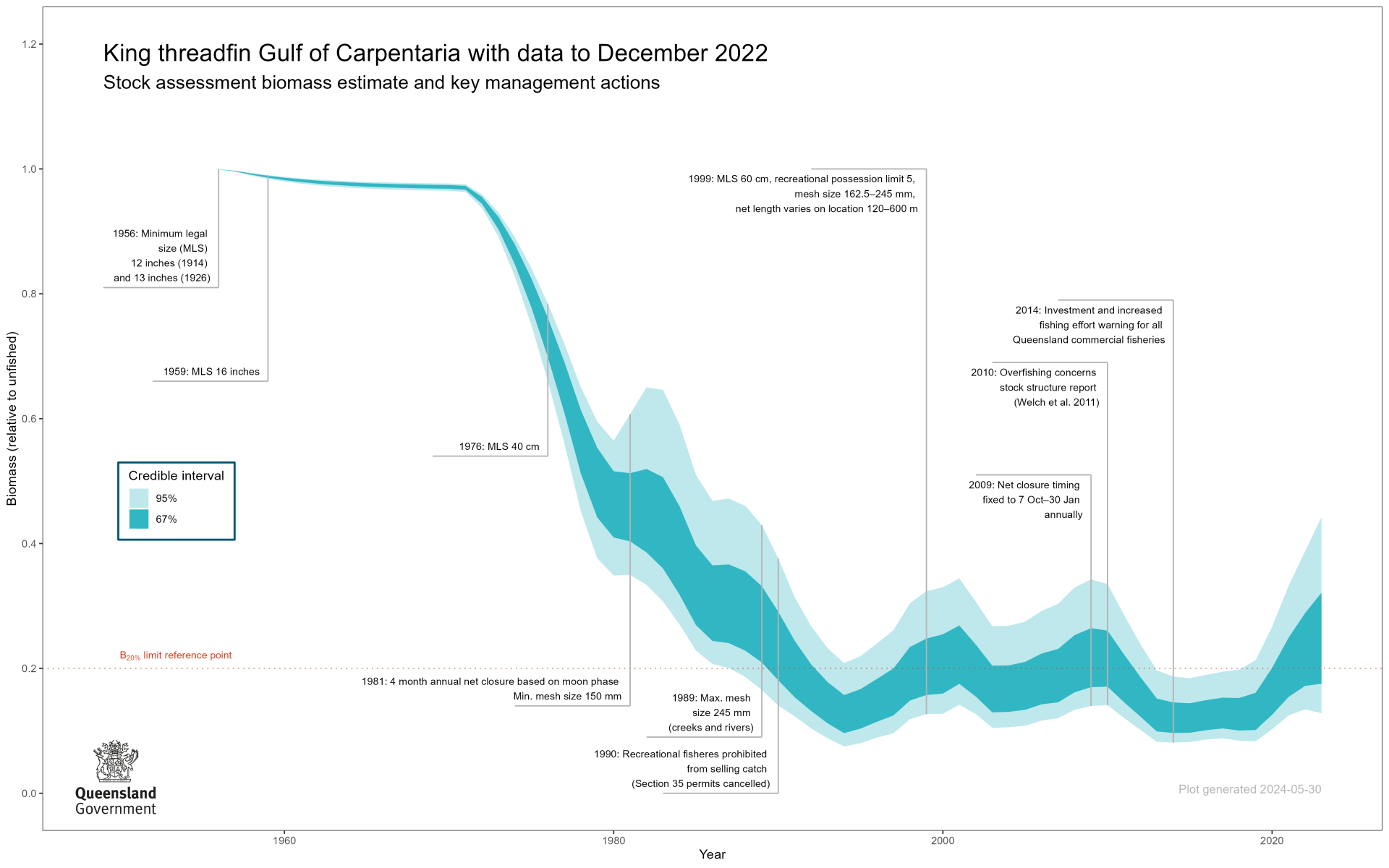
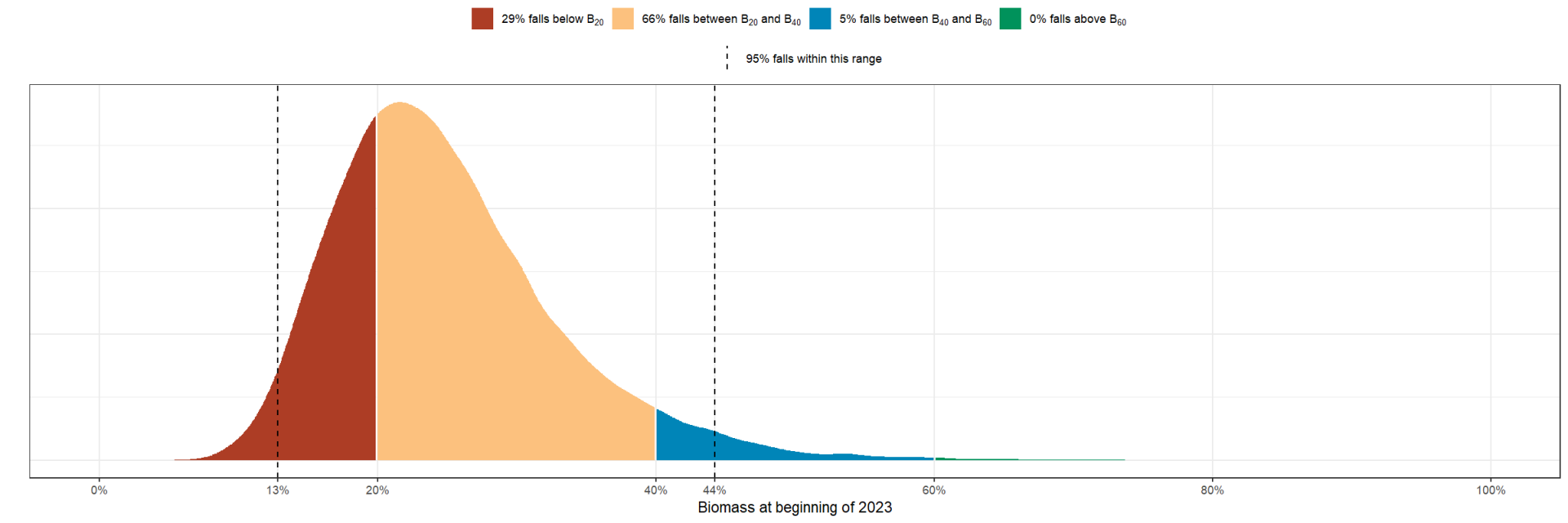
Results indicated that the number of adult king threadfin (spawning biomass) was between 13% and 44% of unfished levels in the Gulf of Carpentaria at the start of 2023.
The model estimated that at the start of 2023 there was 29% chance that the current biomass was below the limit reference point of B20 (20% of the unfished biomass in 1956).
The assessment used Stock Synthesis, a modelling framework that was developed by the National Oceanic and Atmospheric Administration (United States).
Independent review
As best practice, Fisheries Queensland contracted an independent external review of the king threadfin stock assessment.
The reviewers, Dr Simon Hoyle and Alistair Dunn supported the conclusions of the stock assessment results and agreed that the assessment has been competently constructed and is suitable given the available data.
Biomass estimates and key management actions
The chart presents the biomass ratio of king threadfin in the Gulf of Carpentaria from the beginning of 1956 to the beginning of 2023. The ratio is relative to unfished biomass in 1956.
Probability distribution of estimated biomass for the beginning of 2023
The chart presents the probability distribution of the biomass ratio of king threadfin in the Gulf of Carpentaria at the beginning of 2023 across all scenarios with the credible interval and B20 risk threshold indicated.
Estimated retained catch from 1955 to 2022
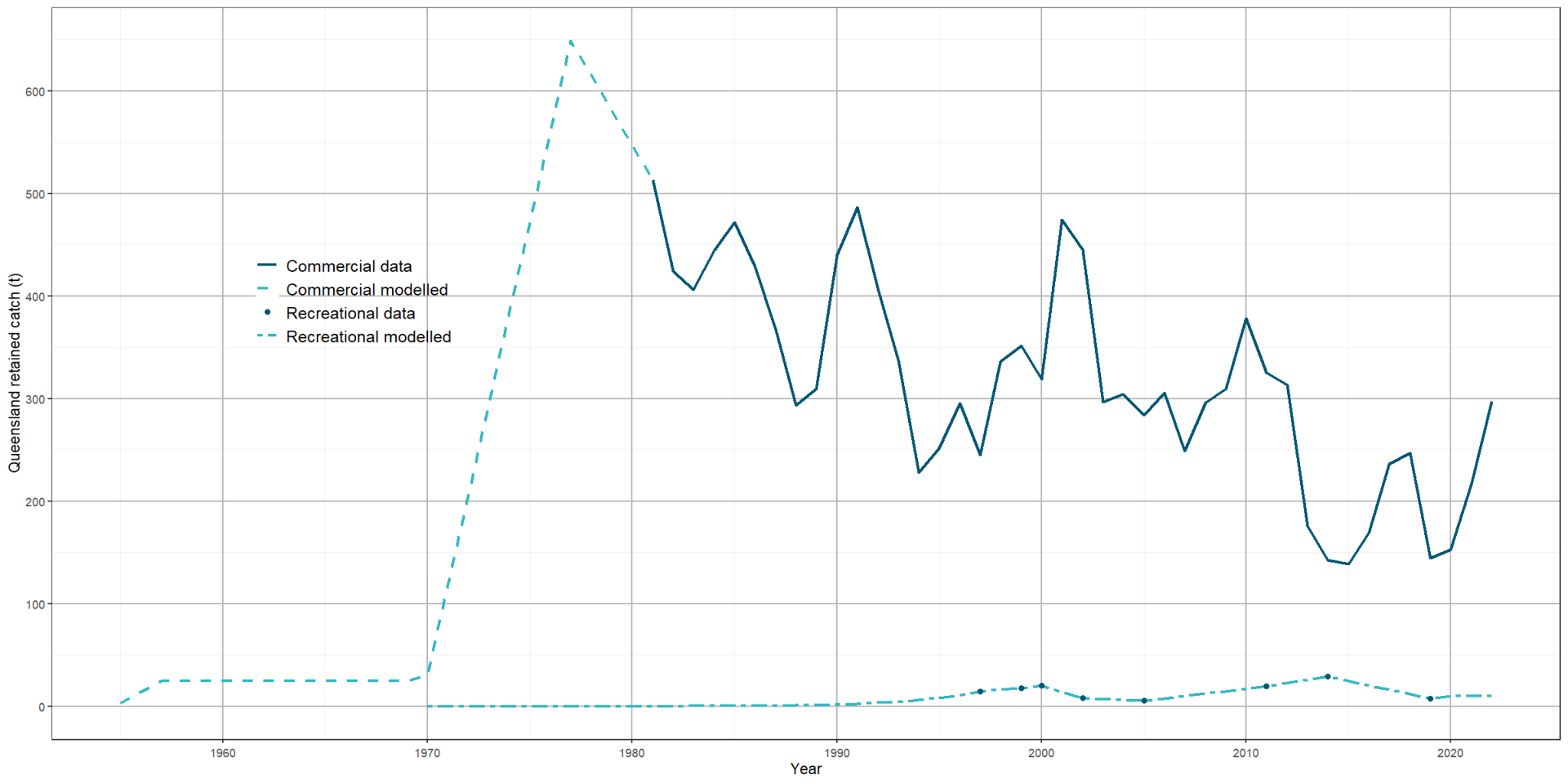
The chart presents retained catch for king threadfin in the Gulf of Carpentaria. The chart shows the data used and the modelled retained catch for the commercial and recreational sectors.
Project team
The stock assessment project team had a wide range of skill sets, and included:
- managers, scientists, monitoring and data specialists from our department
- 3 industry representatives.
The stock assessment project team operated under a terms of reference (PDF, 154KB) to ensure a transparent and evidence-based approach.
We thank the project team for contributing their time and knowledge and engaging constructively over the course of a 16-month project.
We acknowledge the significant time commitment and deep operational and technical expertise of our industry representatives. The project has benefited greatly from their input. Future assessments should continue to engage with industry members to further enhance assessments and build collaboration between industry and government.
East coast stock assessment
The 2020 stock assessment used current biological data, and commercial and recreational catch data to:
- determine the sustainability of fish stocks
- inform management decisions
- inform the development of a harvest strategy.
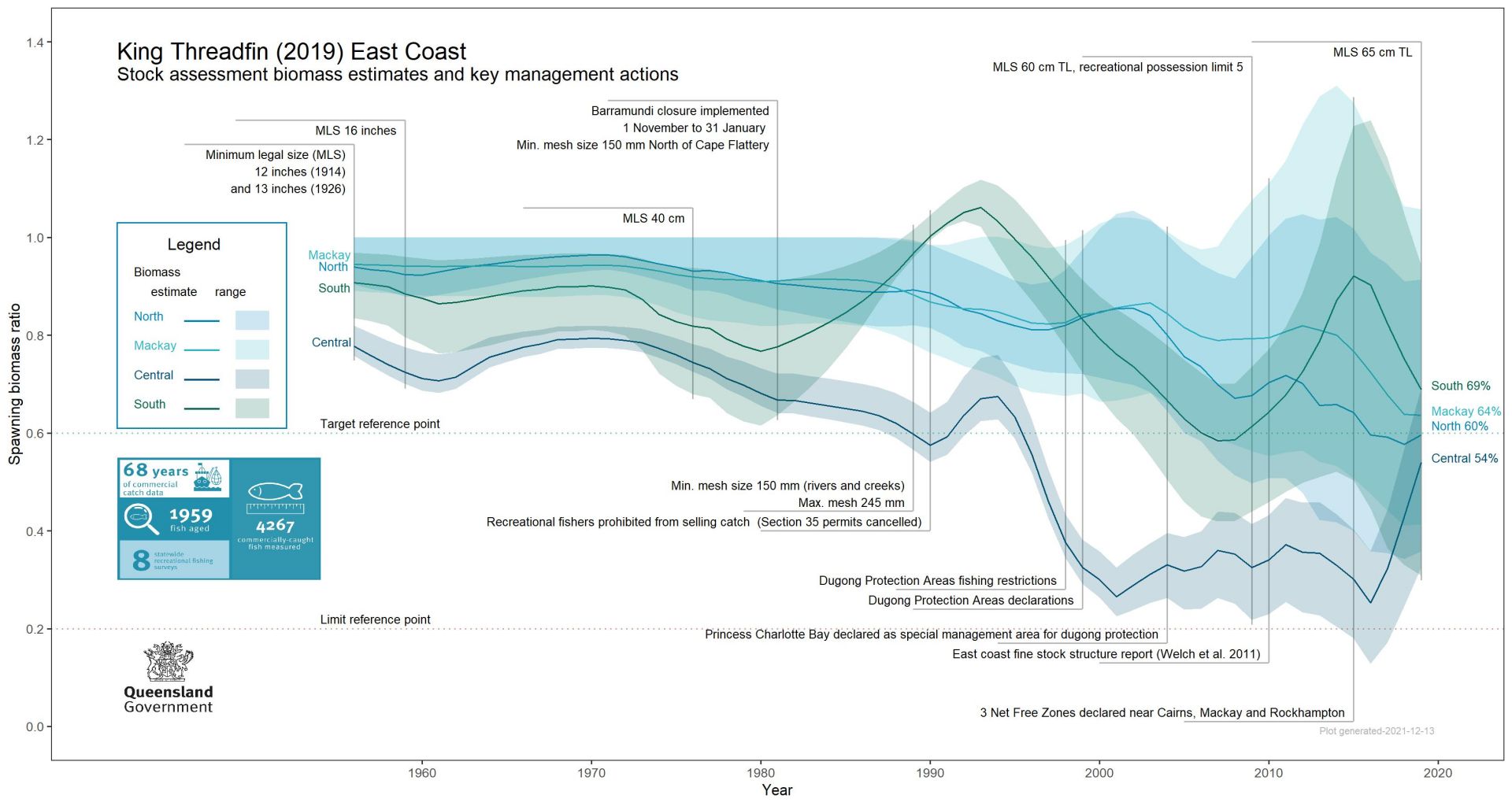
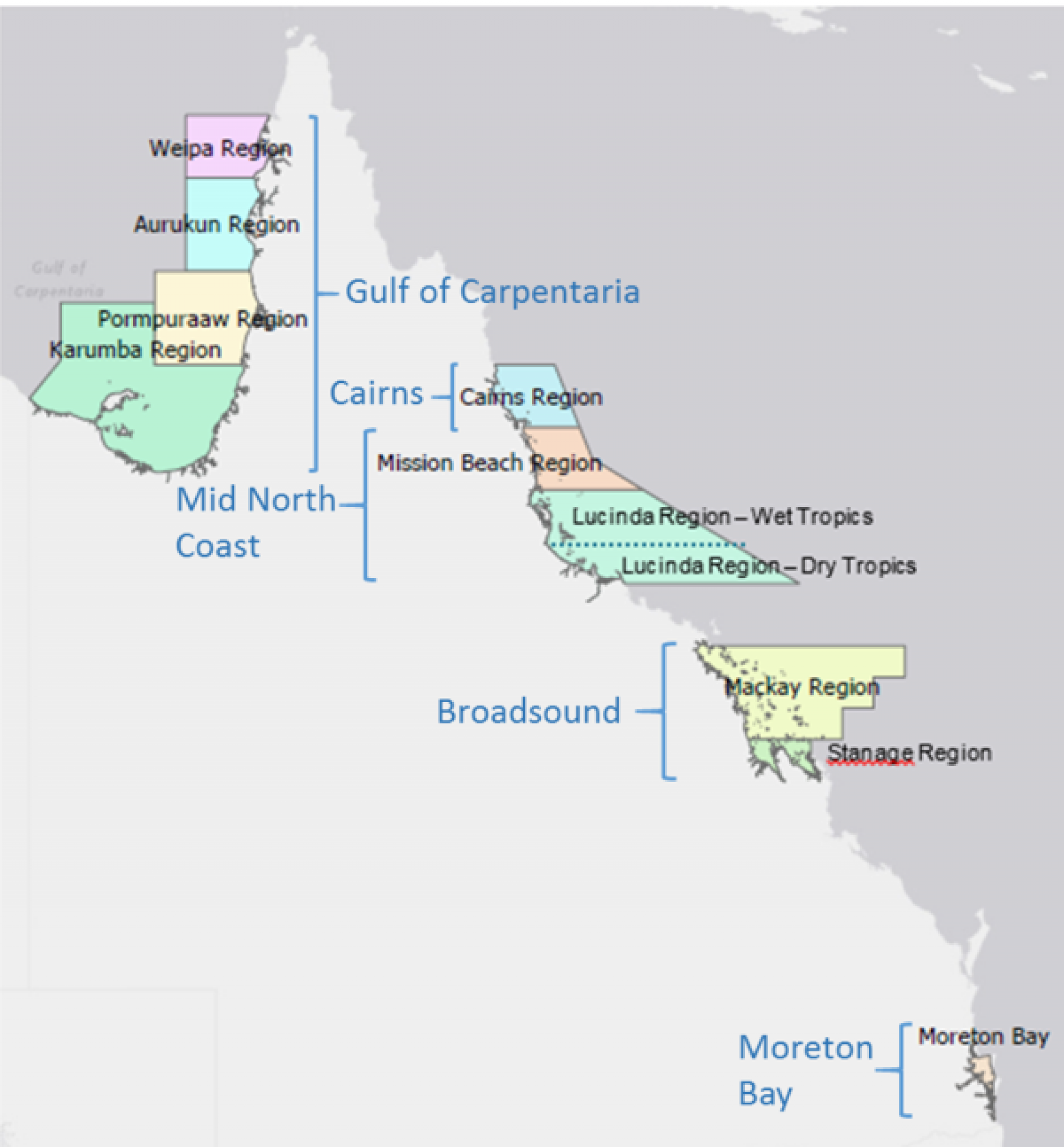
The assessment estimated that the number of adult king threadfin (spawning biomass) was between 54% and 69% of unfished levels for each of the East Coast Assessment Regions in 2019. A region in the far north (AR1) was not assessed due to very small harvest.
A lack of data available for the 2002 assessment caused biomass models to fail and used commercial harvest to produce a potentially useful management target for the whole east coast.
The assessment used Stock Synthesis, a modelling framework that was developed by the National Oceanic and Atmospheric Administration (United States).
Independent review
In 2021, an independent review of the 2020 stock assessment was conducted by Dr Neil Klaer, a former CSIRO fisheries scientist.
This review:
- supported the conclusions of the stock assessment results
- agreed that the assessment has been competently constructed and is suitable given the available data.
Suggestions for improvements included alternative options for:
- catch rate calculations
- handling the way king threadfin catchability (the proportion of the stock taken by an operator per day) may be changing over time.
We have considered these recommendations and will address them in future assessments.
Biomass estimates and key management actions
The chart presents the biomass ratio of east coast King threadfin from 1956 to 2019. The ratio is relative to 1 in 1936. The biomass estimate and range of estimates are presented for North, Mackay, Central and South assessment regions. Data used in the stock assessment includes 68 years of commercial caught fish measured, 1959 fish aged, 4267 fish measured and 8 statewide recreational surveys.
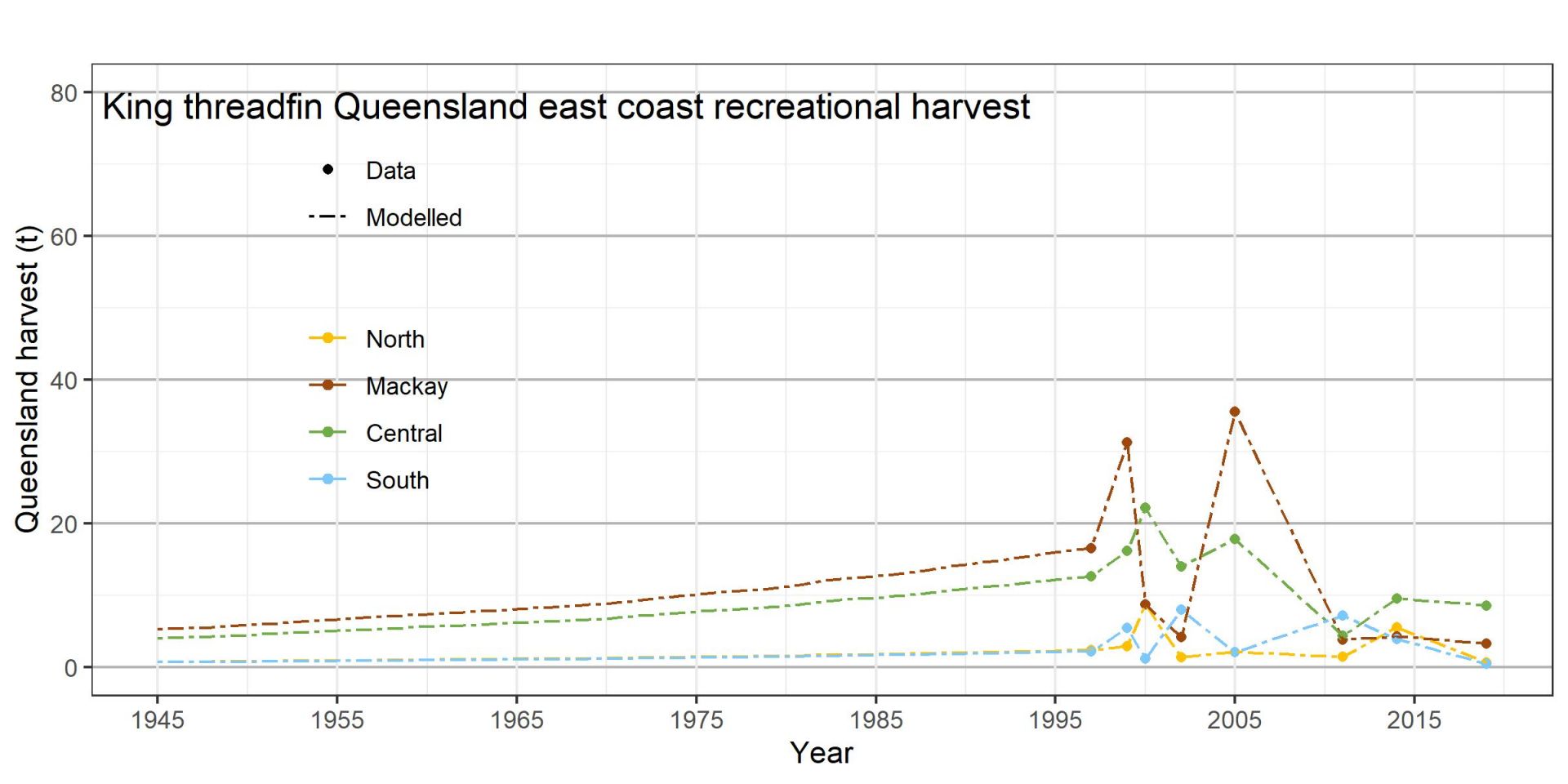
Estimated recreational harvest from 1945 to 2019
The chart presents east coast king threadfin harvest taken by recreational fishers from 1945 to 2019. The recreational harvest is modelled from 1945 to 2019 apart from 1997, 1999, 2000, 2002, 2005, 2011, 2014 and 2019 where survey data is available.
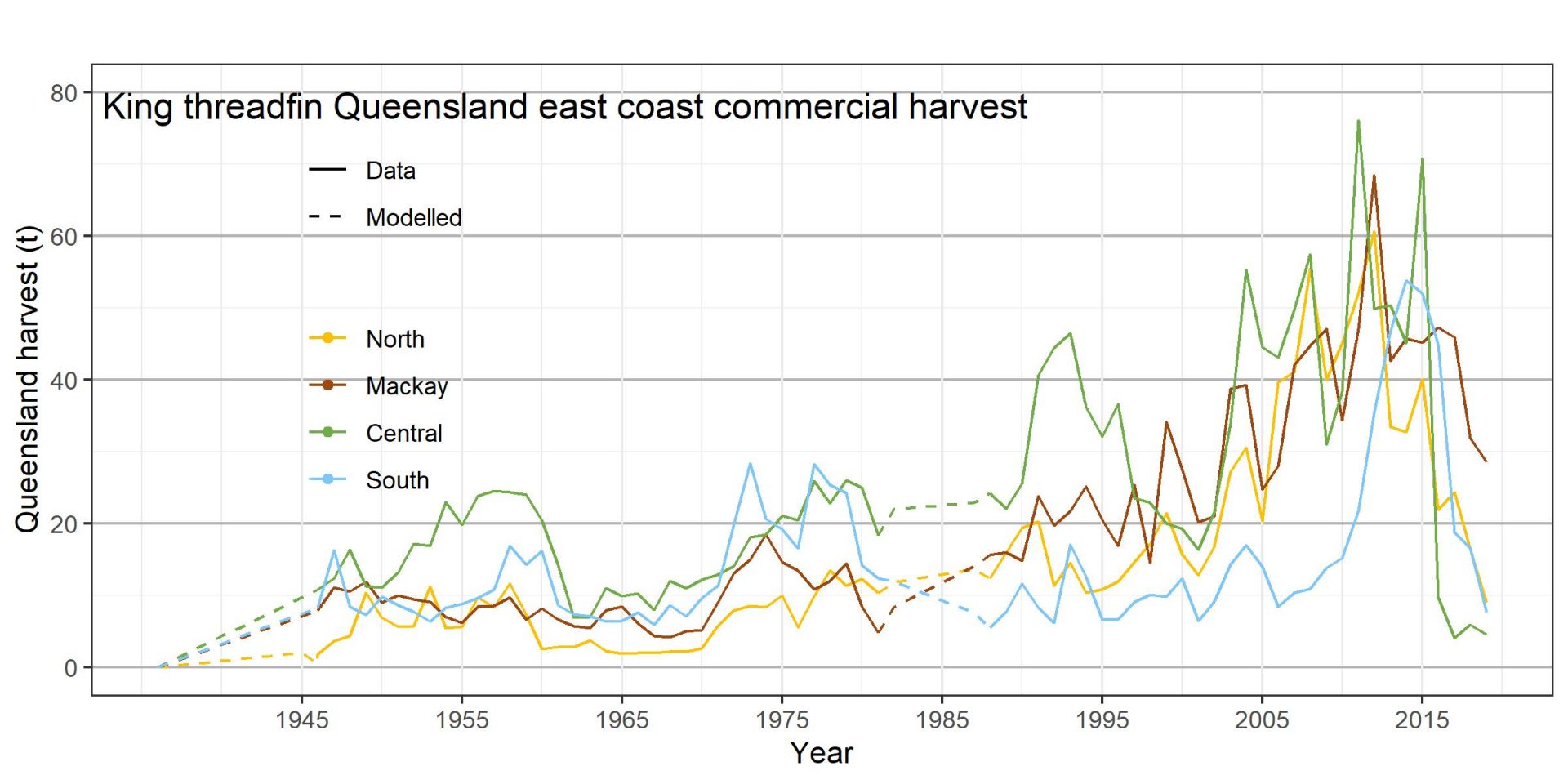
Estimated commercial harvest from 1936 to 2019
The chart presents east coast king threadfin harvest taken by commercial fishers from 1936 to 2019.
Monitoring
The biological monitoring program collects data on length, sex and age of fish caught by commercial and recreational fishers. Both of the Gulf of carpentaria and east coast populations have been monitored since 2016.
Commercial catch data is collected from areas in the Queensland Gulf of Carpentaria and East coast.
Gulf of Carpentaria stock
King threadfin has a single genetic stock in the Gulf of Carpentaria.
Drought conditions and a decrease in commercial fishing effort have contributed to the decline in commercial catches since 2010. Research identified changes in the age and sex ratio composition of the catches recorded in 1986—1990 and those from 2007—2009.
River flows affect the king threadfin fishery, with low flows associated with both lower catchability and a reduction in the number of young produced and/or surviving.
The largest fish measured during the monitoring program was 1600mm total length. The oldest fish aged was 11 years old.
East coast stock
On the Queensland east coast, king threadfin appears to comprise numerous relatively isolated stocks which have yet to be well defined. The growth rate is highly variable within and between stocks.
Commercial and recreational catches on the east coast increased in southern and central Queensland, after the floods in 2010/11 and following years of higher than average rainfall.
The largest fish measured during the monitoring program was 1390mm total length. The oldest fish aged was 20 years old.
Ecological risk assessment
- Gulf of Carpentaria inshore fishery
- east coast inshore fishery.
Management
Gulf of Carpentaria:
East coast inshore fishery:
Last updated: 03 Dec 2024