Species
- Tiger prawns (Penaeus esculentus, P. semisulcatus or P. monodon)
Fish stock status
Although a species may be classified as sustainable under the Status of Australian Fish Stocks (SAFS) framework, this does not mean that the stock is meeting Queensland targets under the harvest strategy.
| Stock | 2023 | 2020 | 2018 | 2016 | 2014 |
|---|---|---|---|---|---|
| East Coast Otter Trawl Fishery | Sustainable | Sustainable | Sustainable | Sustainable | Sustainable |
Stock assessment
The 2023 stock assessment used current biological, survey and commercial catch data to estimate the:
- biomass of the biological stock
- fishing pressure on the biological stock.
The assessment used a delay-difference biomass model based on previous stock assessments for this fishery. 10 scenarios were run, covering a range of modelling assumptions.
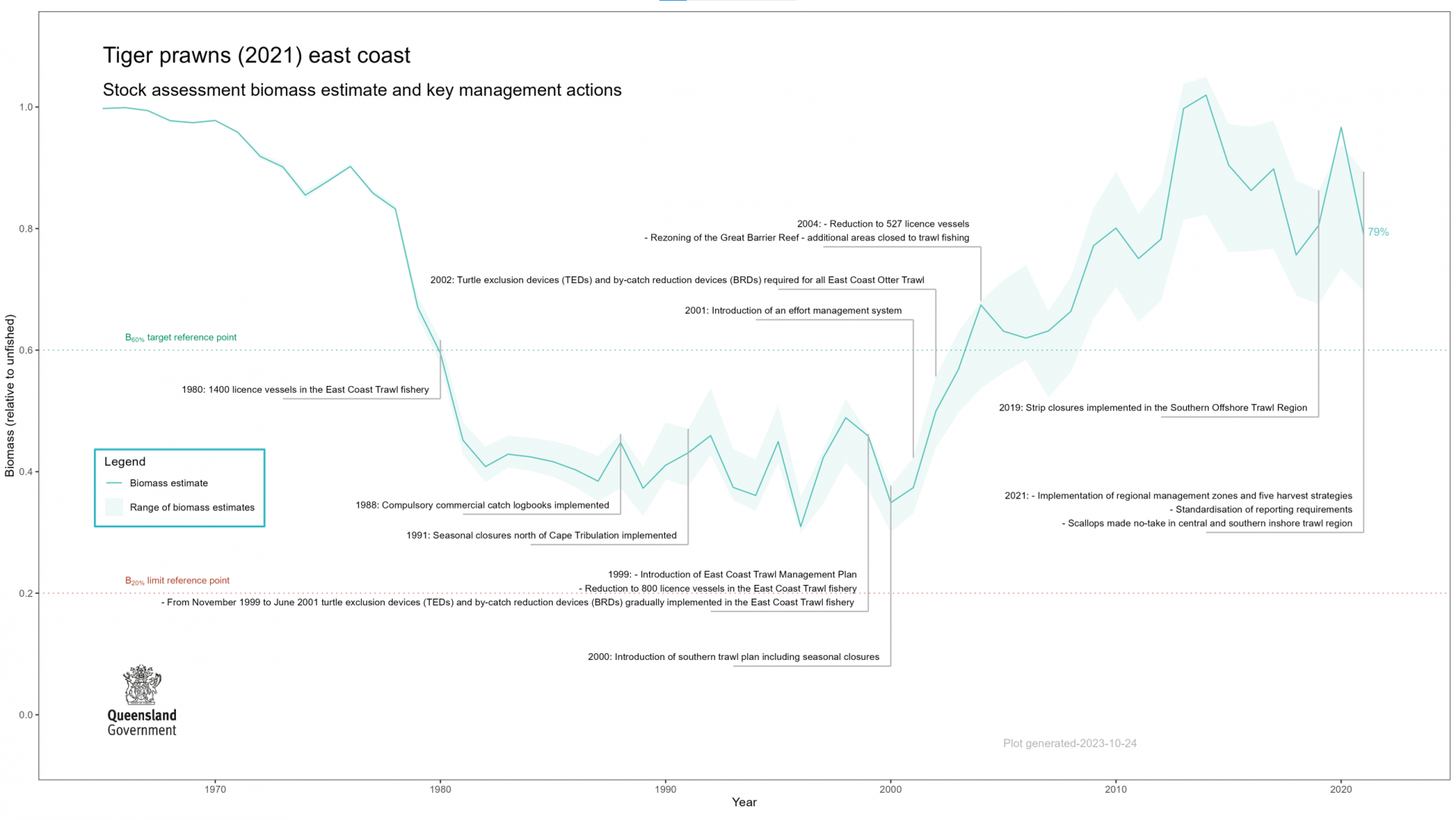
Results for the project team-preferred scenario indicated that biomass in 2021 was between 70% and 89%, most likely at 79% for the east coast tiger prawn stock north of 22 degrees latitude.
Previous reports:
Biomass estimates and key management actions
The chart presents the biomass ratio of tiger prawns from 1958 to 2021. The ratio is relative to unfished biomass in 1958. Data used in the stock assessment includes 63 years of commercial catch data.
Estimated retained catch
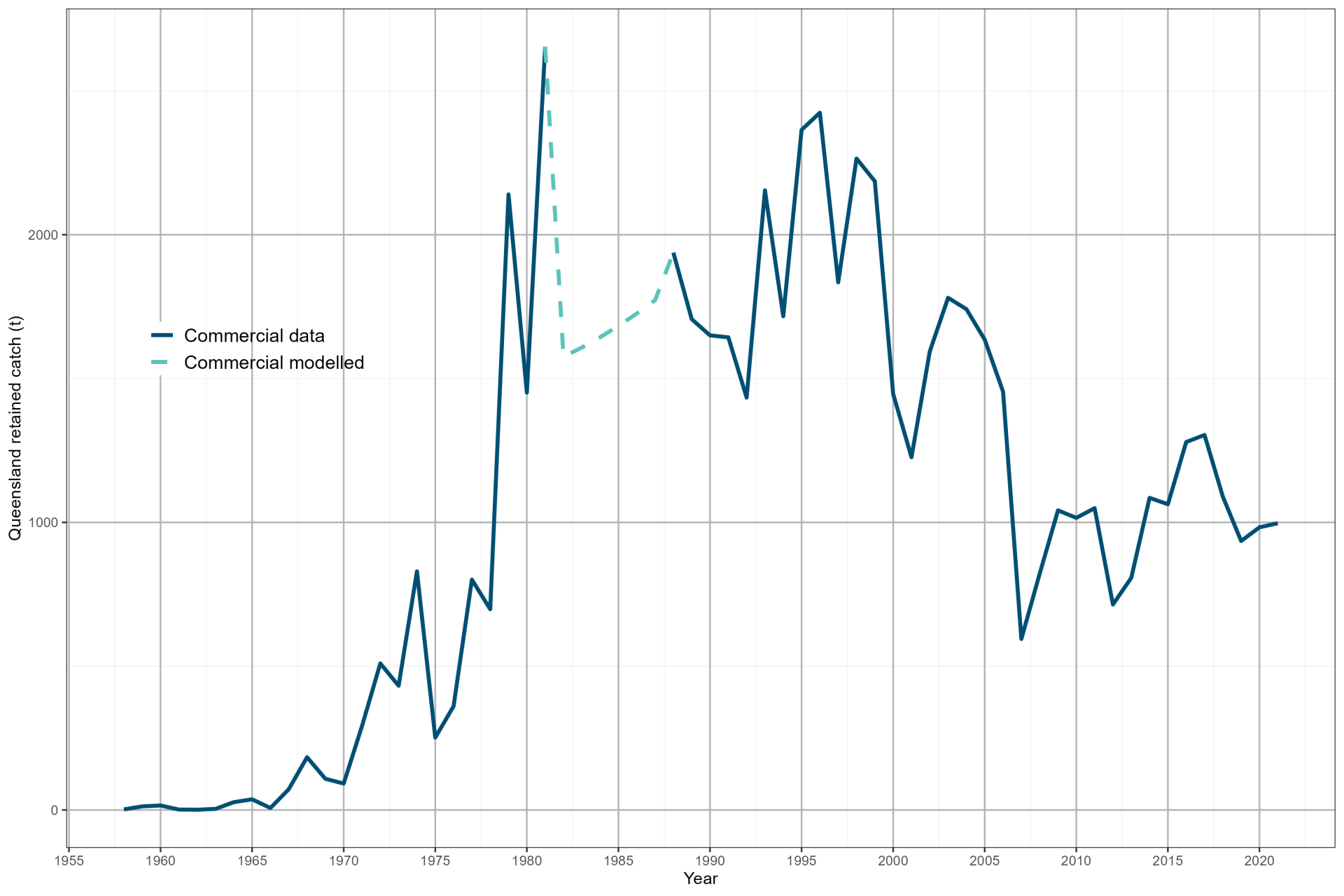
The chart presents retained catch for tiger prawns on the east coast of Queensland from 1958 to 2021. The chart shows the data used and the modelled retained catch for the commercial sector.
Project team
The stock assessment project team had a wide range of skill sets, and included:
- managers, scientists, monitoring and data specialists from our department
- 2 industry representatives.
The team operated under the terms of reference (PDF, 154KB) to ensure a transparent and evidence-based approach.
We thank the project team for contributing their time and knowledge, and engaging constructively over the course of a 17-month project.
We acknowledge the significant time commitment and deep operational and technical expertise of our industry representatives. The project has benefited greatly from their input. Future assessments should continue to engage with industry members to further enhance assessments and build collaboration between industry and government.
Ecological risk assessment
Assessed in the:
- 2018: Southern Queensland east coast otter trawl fishery and river and inshore beam trawl fishery (PDF, 4MB)
- 2012: East coast otter trawl fishery in the Great Barrier Reef Marine Park (led by the Great Barrier Reef Marine Park Authority).
Management
East coast otter trawl fishery:
Last updated: 03 Dec 2024